
What "Agentic AI" Means in Sports Media
A tool waits for instructions. An editor opens it, finds the moment, marks in and out points, exports, uploads. The tool made each step faster, but a human still drives every step.
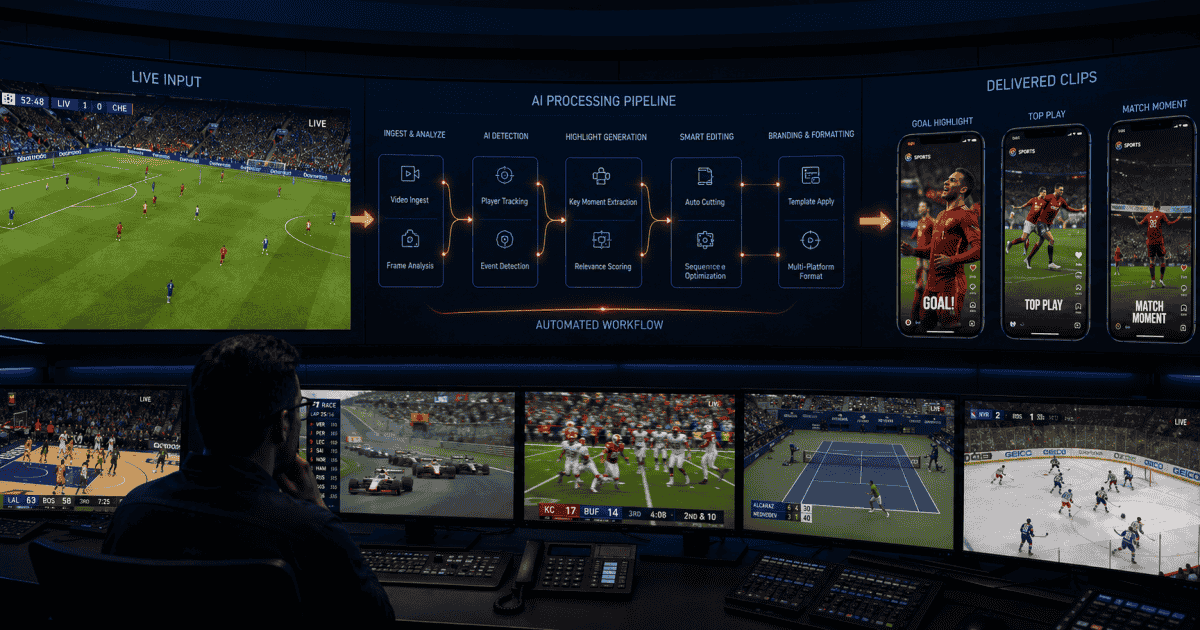
An AI agent operates continuously toward a goal. In sports media, the goal is "turn this live match into publishable content," and the agent pursues it without per-step instructions: it observes the broadcast, identifies patterns that signal a key moment, cuts the clip, applies the right format and metadata and hands a finished asset to a human for approval (or, once trusted, publishes within agreed rules).
The practical definition: agentic AI in sports media is a system that monitors matches, detects key events, creates highlights and completes production tasks without constant human input.
Tools Versus Agents: What Actually Changes
Traditional Tools | AI Agents | |
|---|---|---|
Trigger | Editor initiates every action | Agent acts on match events as they happen |
Speed | Minutes per clip, limited by attention | Seconds per clip, limited by processing |
Coverage | One editor watches one feed | One system watches every feed |
Output | One format, then manual variants | Platform-ready versions generated together |
Scaling | Linear: more output needs more staff | Decoupled: more output needs more compute |
Human role | Operator | Supervisor and storyteller |
The last row is the strategic one. When production no longer scales with headcount, the questions that defined budget planning ("how many matches can we afford to cover?") get replaced by better ones ("which moments deserve human craft on top of the automated baseline?").
This is also why "tools versus agents" is not just a faster version of the same job. A faster tool still caps output at one editor's hours. An agent removes the cap, which means the constraint moves from how much your team can physically produce to what you decide is worth producing. That is a different planning conversation, and it is the one broadcasters who adopt early are already having.
How an Agent Reads a Live Match
Agents do not "watch" the way a person does. They fuse several signal streams at once:
Visual analysis tracks players, the ball and on-screen graphics, recognizing actions like shots, saves, boundary clearances or fast breaks.
Audio analysis listens for crowd surges and commentary intensity, which spike reliably at moments that matter.
Scoreboard and data signals confirm events: a score change, a card shown, a substitution.
Temporal context separates a routine save from a match-winning one by understanding game state: scoreline, clock, competition stakes.
When several signals agree, the agent assigns the moment a confidence score, cuts the segment with appropriate lead-in and celebration and packages it. High-confidence moments can flow straight to publishing queues; borderline ones wait for human review. That confidence threshold is the dial each organization sets according to its own risk tolerance.
A concrete sequence makes this clear. A striker shoots from outside the box. Within the same second, the visual model registers a shot and the ball crossing the line, the audio model registers a sharp jump in crowd noise and commentary pitch, and the data feed posts a score change. Three independent signals agree, so the moment scores high. The agent reaches back a few seconds to capture the build-up, holds through the celebration, trims to a clean end, renders the platform versions and drops the package into the review queue, often before play restarts. Run the same pipeline on a routine throw-in and it scores low, so nothing ships. The intelligence is less in spotting motion and more in weighing how much each moment matters.
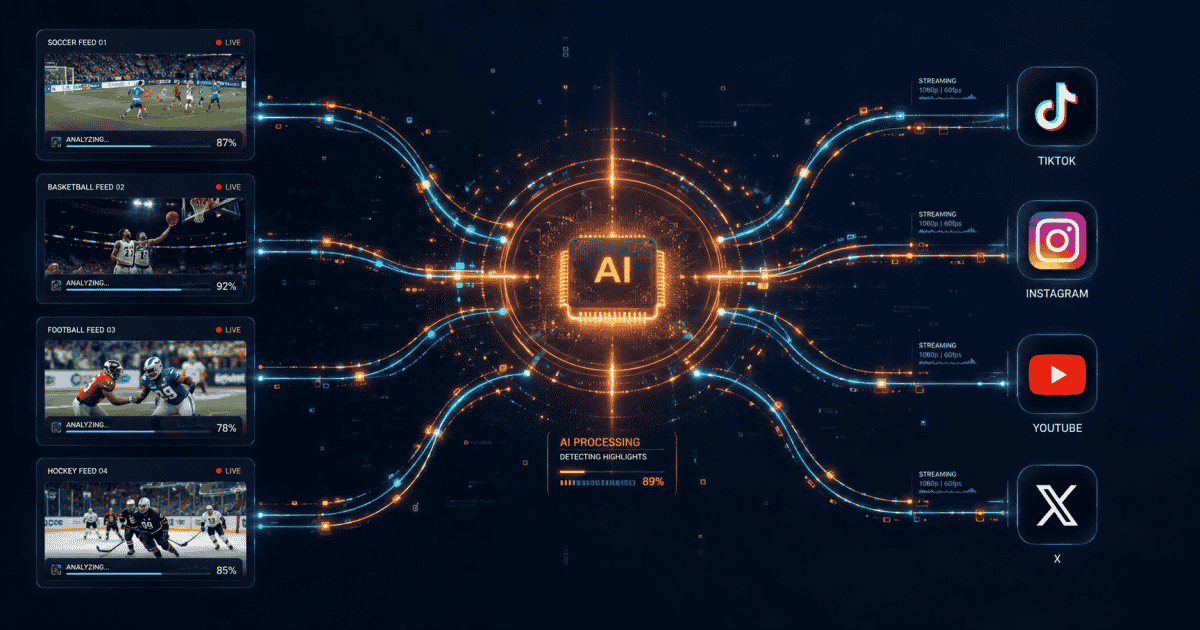
Because this runs on compute rather than human attention, one agent applies the identical process to every feed at once. An editor can follow a single match closely; an agent gives equal, instant focus to ten of them, which is what turns covering a full match-day slate from an aspiration into a routine.
Five Agent Workflows Already in Production
None of the following are hypothetical. Each is a job that used to consume editor hours and now runs as a standing process, with people reviewing rather than producing.
1. Instant highlights. The foundational workflow: goals, wickets, dunks and match points detected and cut in real time. Zentag's platform delivers publishable clips in under 30 seconds from the moment, fast enough to ride the social conversation rather than chase it. (Product detail: AI sports video highlights.)
2. Evolving recaps. The agent maintains a running summary of the match, publishing a halftime version and updating it at full time, so late-arriving fans get instant context. (Product detail: Smart Live Recap, and see how automated recaps are built.)
3. Format adaptation. Every clip is rendered for each destination: 16:9 for broadcast and YouTube, 1:1 for feeds, 9:16 for Stories, Reels and TikTok, with the subject kept in frame automatically. (Product detail: AI Reframe.)
4. Multi-version output. The same play can ship as different products for different stakeholders: a club-branded cut, a sponsor-framed cut, a broadcaster master and a social vertical, generated together rather than queued for an editor's afternoon.
5. Archive enrichment. Everything the agent clips is tagged with players, teams, event types and timestamps on ingest, which quietly builds a searchable library. Six months later, "all of player X's goals this season" is a query, not a project. (Product detail: Archive Media Management.)
Where Agents Still Struggle
Honest adoption means knowing the edges. Detection is strongest on common, well-televised sports with clear scoring events and predictable camera work. It is weaker where the signal is ambiguous: a tangle of bodies in a crowded goalmouth, an unusual angle at a smaller venue, a continuous-play sport with few discrete scoring moments, or a celebration the model has not seen before. In those cases the agent does not manufacture certainty. It returns a lower confidence score and routes the moment to a person, which is exactly the behavior you want.
The harder gap is meaning. An agent can reliably tell that something significant happened. It cannot always tell why it matters. A late equalizer in a dead-rubber friendly and the same goal in a title decider look almost identical in the pixels but carry very different weight. Game-state context closes some of that gap, but the final read on significance, controversy or sensitivity stays human. This is the practical reason to treat the agent as a tireless first pass rather than a replacement for the desk: it removes the volume problem so editors can spend their judgment where judgment is the whole point.
What Stays Human
Agents take over repetitive, time-critical and rule-based work. They do not replace editorial judgment, and organizations that pretend otherwise produce worse content. Humans keep:
Storytelling. Agents assemble moments; editors craft narratives, context and emotion around them.
Brand voice and taste. What your channel publishes, in what tone, with what restraint, remains a human call encoded as rules the agent follows.
The judgment calls. Controversial moments, injuries, crowd incidents: anything reputationally sensitive should route to a person by policy.
Quality control. Spot-checking output and tuning detection thresholds is an ongoing editorial task, lighter than cutting clips but more important.
The honest framing: agents give editors back the hours they spent scrubbing timelines, and the organizations that win reinvest those hours in the creative work fans actually notice.
New roles tend to emerge rather than disappear. Someone owns the rules the agent follows and tunes them as the season changes. Someone curates the automated baseline into bigger stories: the weekly montage, the player feature, the rivalry retrospective that the clips now make trivial to assemble. The job shifts from producing every asset by hand to directing a system that produces the routine ones, and that shift tends to make editorial work more interesting, not less.
How to Prepare Your Team
Step 1: Audit the workflow. List what your editors do on a match day, hour by hour. Mark every task that is repetitive, time-based or rule-based. That marked list is your automation candidate set, and it is usually 60 to 80 percent of the hours.
Step 2: Pick one competition and pilot. Run an agent on a single feed alongside your existing workflow for a few weeks. A working pilot typically takes about 30 days to set up and evaluate. Compare time-to-publish, clips per match and engagement directly.
Step 3: Set the guardrails before scaling. Decide confidence thresholds, define the always-review categories and agree what "publishable without review" means. Guardrails set early prevent the one bad clip that sets the program back a year.
Step 4: Scale by competition, not by task. Once one feed runs reliably, add the next competition. Coverage you previously could not afford (youth, women's, regional fixtures) is usually where agents add the most net-new value, as mid-tier leagues using AI highlights show.
What to measure. Three numbers tell you whether the pilot is working. Time to publish: how long from the moment happening to a clip being live, where the target is seconds, not minutes. Coverage: clips produced per match versus what the manual workflow managed, since the gain usually shows up as moments you simply never had time to cut before. And review load: the share of output that needed a human edit, which should fall steadily as you tune the confidence thresholds. If those three move in the right direction over a month, the case for scaling makes itself.
The 2026 Standard
Adoption is setting new baseline expectations for everyone:
Every match becomes instantly shareable. Automated highlights keep fans engaged minute by minute, not at the end of the day.
Multiple versions of the same play coexist. Teams, athletes, sponsors and broadcasters each get their own tailored cut.
Production stops scaling with staff. Bigger content operations no longer require proportionally bigger teams.
Broadcasters who built these capabilities early treat them as daily norms. For everyone else, the gap compounds weekly: every match produced the old way is dozens of clips that never existed, fans never reached, inventory never sold. The next chapter of sports broadcasting will not be defined by who has the most tools, but by who lets agents do the repetitive work so people can do the creative work.