
Credit first. This Insight is a reading of Sport's age of discovery: How smart content distributors are addressing the fragmentation challenge, published by SportsPro in August 2026 with Gracenote, the content intelligence business unit of Nielsen. The figures, platform examples, and executive quotes below come from that paper and the third-party studies it cites. They are not Zentag AI research.
There was a time when watching live sport meant gathering in front of one linear broadcast. That world is gone. In 2026, as the paper opens, American NFL fans who want every game must navigate no fewer than six broadcast networks and five streaming services. NBA games in the domestic market can sit across as many as five subscriptions. In many European countries, soccer fans need multiple subscriptions to see the top competitions. Rights holders chase revenue and younger demographics on connected TV, streaming, and social. Netflix, Apple, and Amazon now hold premium properties such as the NFL, Formula One, and the Champions League in select markets. Legacy media companies deepen DTC catalogues. vMVPDs add another layer of connected TV fragmentation. The by-product for fans is a familiar frustration: more subscriptions, and still trouble locating the live match or the related content they actually want.
Against that backdrop, the paper's thesis is blunt. The platforms best positioned to succeed are not necessarily those that offer the most content. They are the ones bridging the discoverability gap with experiences that connect fans to a live game, a related docu-series, or a highlights package that keeps them on the platform between broadcasts. Content discoverability is now a commercial problem with implications for user experience and the long-term health of the sports media ecosystem.
What fragmentation costs on the couch
Gracenote's State of Play 2025 research, as cited in the paper, puts numbers on that frustration. Twenty-five percent of viewers have tried to watch a specific programme, sports event, or movie but were unable to find it on a streaming service. Nearly 50 percent would consider cancelling a subscription because they cannot find what they are looking for, rising to 56 percent among those aged 25 to 34. Nineteen percent give up on a viewing session entirely if they cannot easily find something to watch; among 18 to 24-year-olds, that figure rises to 29 percent. Forty-five percent of streaming viewers say content saturation is overwhelming. Thirty-two percent say the abundance of choice makes the overall experience of TV less enjoyable.
Demand for a better guide is equally clear in the same research. Sixty-six percent of streaming viewers want their service to tell them where to find a specific programme, even if it is on a different service. The same proportion would prefer a single guide or menu, similar to cable television, where content across multiple services can be searched.
These complaints sit next to expensive sports rights. Tyler Bell, senior vice president of product at Gracenote, puts the risk plainly in the paper: "Frustrating sports-hungry viewers is a bad idea. At best they abandon the session; at worst, they abandon the platform." He continues: "Broadcast rights are expensive; viewership is the reward. The services best positioned to win are those that make it easy to get their viewers watching."
Discovery hubs, schedules, and not getting in the way
In response, some distributors have launched consolidated content hubs that point fans to where they need to be. Aggregators increasingly direct viewers to a specific game regardless of channel or service. Sports streamers typically still do not tell viewers where to find a game on another service (the paper notes ESPN's "Where to Watch" as a notable exception), even as consumer demand for that kind of help grows.
Fubo is one operator the paper highlights for redesigning around findability. Its platform tells users what percentage of games featuring their favourite team is available on the service, and it updated its mobile app based on user feedback to make the schedule easier to find. Isaac Josephson, senior vice president of product management at Fubo, says in the paper: "Understanding a little bit more about what our users wanted gave us the fuel that we needed to redesign that experience."
Smooth discovery in a live context depends on accurate, up-to-date sports scheduling data. When that information is incomplete or inconsistent, hub features break down. Normalised content metadata and consistently updated schedules become critical assets. The paper points to WBD's Olympic challenge as an extreme case: during the Games, its streaming platforms might have to deliver live coverage of 50 concurrent events to viewers in dozens of European markets. At Paris 2024, a live schedule housed within the HBO Max platform reportedly delivered 3.8 million plays, and its "My List" feature was said to have been responsible for 80 percent of the live events users added to their watchlists, helping more people engage with content after watching what they originally came for.
David Gibbs, senior vice president of global sports product at Warner Bros Discovery, frames the product job in the paper as a double discovery problem: first arrival, then continued watching, without obstruction. "It's really about the discovery experience when the customer first comes to the product, and then the discovery experience whilst they're watching things, but never getting in their way," he says. "[It's about] honouring the intent that they've got, which is watching the piece of content they've come to [watch], but giving them all the tools to find other stuff when they are finished." Helping users find the games they want is only part of the equation. When underpinned by reliable sports data, platforms can also put scores, tables, schedules, timelines, and statistics in one place. The paper cites DAZN's Scores feature as an example that consolidates that information across hundreds of competitions.
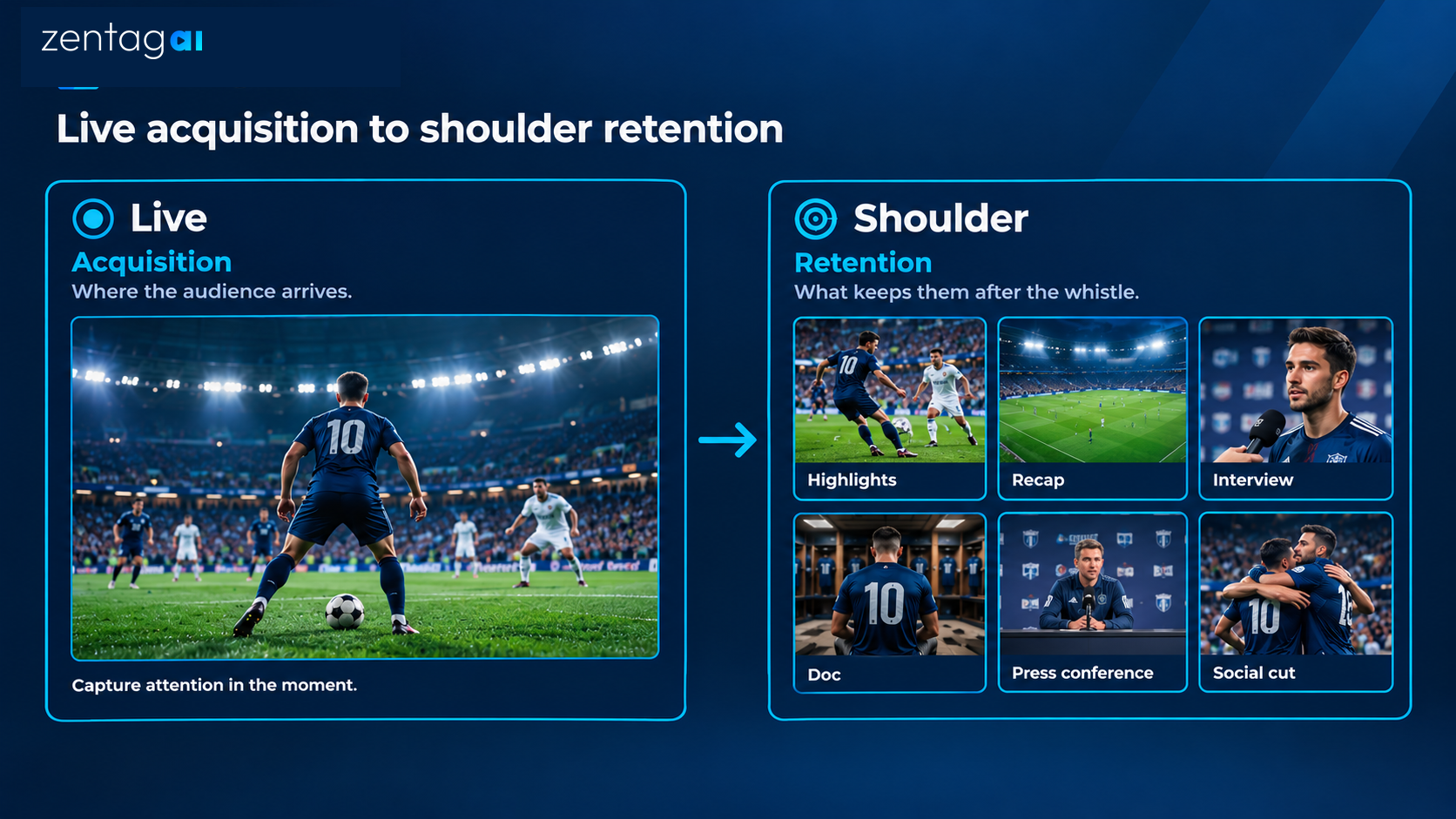
Live for acquisition. Shoulder content for retention.
Discoverability also extends beyond a platform's own walls. FloSports distributes FAST channels across Amazon Prime Video, Fubo, and Roku, and Dave Stelnik, the company's vice president of business development, says in the paper that those platforms are "all making investments" to make discoverability "more seamless". On-platform and off-platform strategies both matter.
The paper's second major move is to treat non-live sports programming as a retention asset in its own right. Shoulder content (pre- and post-game coverage, interviews, highlights, archive footage, films, and docu-series) is now an established part of sports fans' diets and a significant opportunity to prolong engagement between live broadcasts.
The scale of that opportunity is backed by third-party surveys the paper cites. According to the IBM Sport Survey Report 2025, more than half of fans use video highlights to stay connected to their favourite sports, 37 percent turn to post-event recaps, and 32 percent rely on player interviews. Affinity is even stronger among younger audiences. Altman Solon's Global Sports Survey 2026, as cited in the paper, finds that 18 to 34-year-olds spend three times longer consuming non-live formats than they do watching live sports.
The paper's framing is memorable for a reason: if live sports is the primary acquisition tool, related content is the key to retention. Platforms that surface non-live programming intelligently (linking it to a game a fan has just watched, or surfacing it as the live broadcast ends) are more likely to create stickier experiences that keep users inside their ecosystems longer.
Without that connective tissue, a viewer who has just watched a Formula One Grand Prix on Apple TV may not know that a related feature film sitting on the same service is one click away. On WBD's HBO Max, the paper describes long-form documentaries, full-event replays, short-form highlights, and mid-form recaps built into the post-event experience, surfaced automatically and through personalised rails as a live broadcast ends rather than left for users to hunt. Gibbs sees the breadth of the portfolio as a way to move viewers between content categories after live ends. "Bringing sports and entertainment together in one product is the right thing for us to do," he says in the paper. "It's the simplest and easiest way for the customer to discover all the content, and it's our best opportunity to drive engagement." Elsewhere he states the retention logic directly: "The objective is really to drive engagement. A customer who spends longer with us more frequently is less likely to leave because they're getting more value out of their subscription."
Tyler Bell's contribution in this chapter is the infrastructure recipe. Delivering a connected experience, he argues in the paper, requires platforms to cross-reference non-live programming with live broadcasts using content intelligence: universal content IDs and a unified, standardised metadata layer across live games and related programming, so relevant documentaries or behind-the-scenes series can be recommended when the viewer is most receptive. "There are three critical ingredients to an effective sports hub: accurate and timely sports data; linked, exhaustive content metadata; and great user experience," Bell explains. "The first provides the statistical and informatic context about each team and league; the second gets the fan right to 'where to watch' the live event, recaps, and related viewing options; the third makes it easy to navigate and intelligently (and ideally, proactively) respond to a fan's preferences. It's about the data, the content and the interface that brings them together."
Personalisation when abundance stops being fun
As of Q2 2026, Gracenote Data Hub figures cited in the paper count 38,500 sports shows, episodes, games, and events across Prime Video, Apple TV, Disney+, Netflix, Paramount+, and HBO Max, accounting for five percent of all content on those services. Set that against the State of Play saturation figures above, and the volume looks less like fan heaven and more like a curation problem.
In that context, connecting the right viewer to the right content can be the difference between a loyal subscriber and churn. Preference setting on first entry (favourite teams, sports, formats) is only the start. Tubi, which the paper notes claims a long-form library of 300,000 movies and TV episodes including sports documentaries, has put years of investment into the personalisation engine that powers on-platform discovery. Ranking on its homepage runs horizontally and vertically on personalised recommendations, and the quality of that experience, the paper notes, depends on the richness of the underlying data. David Salmon, executive vice president and managing director of international at Tubi, stresses metadata as the decision layer: "Content metadata plays a key role in understanding the content objects in our platform. A big part of the decision-making process is understanding the linkages between pieces of content to then determine whether or not they're appropriate to show the user next."
Fubo's homepage, Josephson describes in the paper, is informed by viewing history, content metadata, and time-of-day signals, with 80 percent of carousels personalised to some degree. On HBO Max, Gibbs says every individual's homepage is algorithmically optimised based on viewing behaviour, so a sports fan sees sports surfaced more prominently than someone who primarily watches films.
Fans are asking for that care. According to IBM, as cited in the paper, 65 percent of fans say personalisation capabilities would improve their digital sports experience, and 30 percent identify personalised content as their top priority for AI-enhanced sports engagement. Bell's definition of a fragmentation-free personalised experience, quoted in the paper, is proportion and proactivity: events, titles, and news of interest receive the proper share of attention, and topical information reaches the user before it is requested. "Push, don't wait for pull." Done well, real-time scores, related data, imagery, and links to related content are waiting when the user opens the app. Preferences must be learned or requested. That is its own science.
AI as the discovery layer
Consumer expectations are already moving toward AI-assisted discovery. Capgemini research cited in the paper finds that 64 percent of fans want AI to share personalised sports-related content tailored to their preferences. Separately, Gracenote's State of Play 2025 research found that 59 percent of people see AI as having the potential to become their favourite source of entertainment information, while 66 percent believe it will be very or extremely important in providing good entertainment experiences.
One platform example the paper highlights is ESPN's "SportsCenter For You": AI-generated video roundups based on the events, teams, and stories that matter most to the individual subscriber. ESPN claims, as reported in the paper, that the format has driven a 65 percent increase in short-form video consumption since launch, complementing rather than cannibalising existing viewership.
More broadly, the paper notes platforms using AI for identifying relevant moments, curating recommendations, thumbnail generation, image formatting, semantic content mapping, and dynamic scheduling. Tubi became the first streaming service to build a native ChatGPT integration, so users can access its full catalogue through conversational queries, and Salmon frames the wider goal in terms any content owner should note: "We want to make sure that Tubi content is very well indexed and very well understood by all the major large language models, so that, if you're a consumer, you can always find the content you want to watch next." Fubo is using AI to scan games and sports talk shows to surface highlights and segments relevant to individual users in near real time, and is exploring generative AI embeddings and voice-driven discovery as future frontiers.
Bell's line on why this matters lands cleanly: "AI is so interesting because humans (consumers and developers) do not need to adapt to strict computer rules; instead, the computers adapt to us and all of our subjectivity and imperfection. This is really the heart of personalisation." He adds that understanding users implicitly and explicitly will bring new viewing experiences, improved search, discovery, and recommendations through natural-language queries, with LLM-powered interfaces able to harmonise standardised programme information with up-to-date schedule data, helping fans who know what games they want but not where to find them overcome fragmentation.
What the paper says platforms can do now
The closing recommendations in Sport's age of discovery are practical enough to pin on a product wall:
Commit to better user experiences. Build comprehensive destinations that aggregate live events, schedules, scores, and shoulder content in a single, easy-to-navigate environment.
Treat non-live content as a retention tool. Pre- and post-game coverage, highlights, interviews, documentaries, and sports-related movies should attract audiences and prolong session times beyond the live event. Surfacing that inventory intuitively is what separates platforms that retain subscribers between events from those that watch them leave.
Build the infrastructure. The UX is only as strong as the data layer beneath it. Content intelligence (unique programme IDs, a unified standardised metadata layer, and rich imagery) makes it possible to sync live games with surrounding programming.
Personalise. Algorithmically optimised homepages and tailored recommendations reduce friction, support retention, and help ad monetisation.
Measure what matters. Time spent on the platform, repeat visit rates, and daily-to-monthly active user ratios reveal whether the experience is working. Subscription and advertising revenue follow from there.
None of that requires every distributor to match the catalogue depth of a global studio stack. It does require treating discoverability and shoulder content as product strategy alongside the live rights deal.
Where Zentag AI sits in this picture
Gracenote's lane in the paper is content intelligence for search, discovery, and navigation across the media ecosystem: standardised indexing, sports discovery hubs, metadata via API. That is Gracenote's business. Zentag AI does not power Gracenote, ESPN, Fubo, WBD, Tubi, or any platform named above.
What Zentag AI builds is the production and packaging side of the retention story the paper describes. If live is acquisition and shoulder content is retention, someone still has to create, cut, reframe, caption, and store that shoulder inventory at the pace a multi-fixture slate demands. That is the work:
AI sports highlights pipeline: detect and package on-pitch moments into professional-grade clips so highlights are available while the conversation is still live, not only after an overnight edit.
Smart Live Recap: structured recap output that can sit next to the live destination as the broadcast ends, when the paper says fans are most receptive to related viewing.
Transcript and spoken clipping: press conferences, post-match interviews, punditry, and podcasts become searchable speech and publish-ready soundbites; the interview and quote layer IBM's survey shows fans already use.
AI Reframe and formats: horizontal masters into vertical and square cuts for the destinations where non-live consumption actually happens.
Archive Media Management: a searchable library of clips and full recordings with metadata context, so editorial and digital teams can find related assets instead of re-scrubbing timelines. It is the same "linkages between pieces of content" mindset Salmon describes for Tubi's recommendation stack, and the same well-indexed, well-understood principle he applies to LLMs, brought to your own production archive.
The competence claim is modest and operational. Platforms need hubs, schedules, and personalisation. They also need a reliable supply of non-live sports inventory that is cut, formatted, and findable. Zentag AI is built for that supply chain inside broadcaster and rights-holder stacks: ingest, detect, clip, enhance, library, distribute.
If you are redesigning how shoulder content is produced and surfaced between live events, see how the Zentag AI pipeline fits your footage and your stack. Book a demo.