
Why Vertical Sports Content Outperforms Landscape on Every Platform
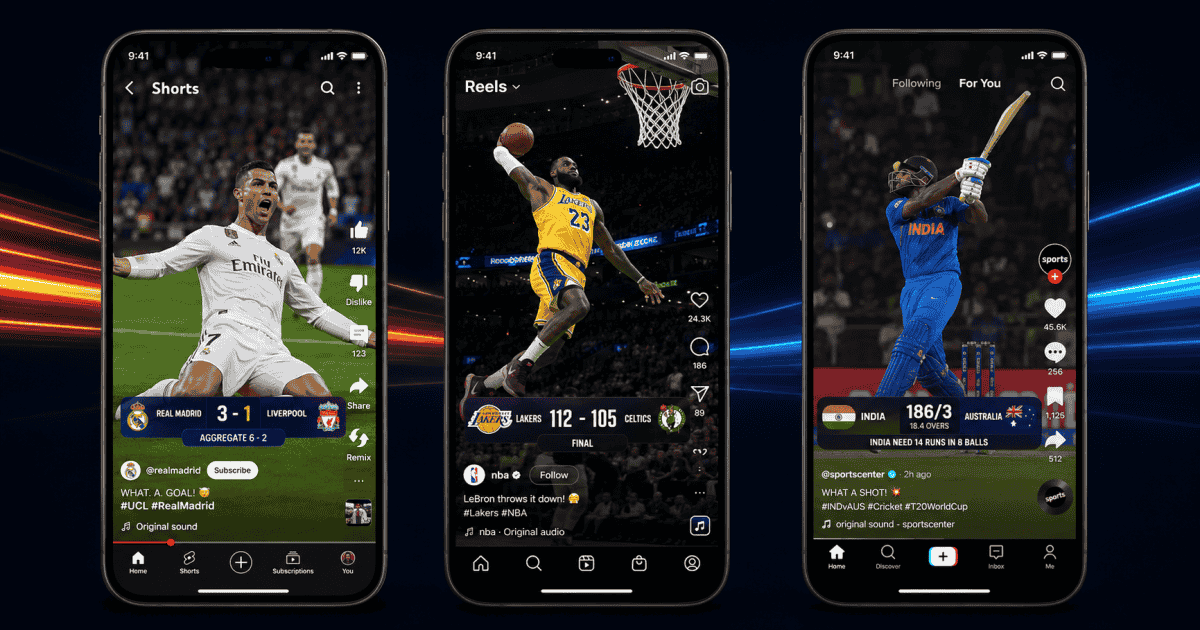
The numbers are not subtle. Vertical video on Instagram generates 48% more engagement than landscape posts. YouTube Shorts with vertical framing get recommended 2.5x more often than landscape uploads repurposed into the Shorts shelf. TikTok's algorithm explicitly favors native 9:16 content over letterboxed landscape clips with black bars.
For sports organizations, this creates an uncomfortable reality. The broadcast feed is 16:9. The camera operators frame for television. The production trucks output landscape. But the audience lives on vertical platforms. Over 70% of sports video consumption for fans under 35 now happens on a phone held upright. If your highlights are not formatted for that experience, they are structurally disadvantaged before a single viewer swipes past.
The organizations that recognized this early (NBA, La Liga, Premier League digital teams) invested in dedicated vertical production crews. They had the budget to do so. For the thousands of leagues, federations and broadcasters without a separate social production team, the question is not whether to produce vertical content. The question is how to do it without doubling their production workload.
Platform Specs That Most Sports Organizations Get Wrong
Each platform has specific requirements and algorithmic preferences that affect how your sports clips perform. Getting the basics wrong means the algorithm suppresses your content before a single fan sees it.
Spec | YouTube Shorts | Instagram Reels | TikTok |
|---|---|---|---|
Aspect ratio | 9:16 (required) | 9:16 (preferred) | 9:16 (preferred) |
Max duration | 3 minutes | 3 minutes | 10 minutes |
Sweet spot | 30-45 seconds | 15-30 seconds | 15-60 seconds |
Resolution | 1080x1920 | 1080x1920 | 1080x1920 |
Captions | Auto-generated, editable | Manual or auto | Auto-generated |
Hook window | First 3 seconds | First 2-3 seconds | First 1-2 seconds |
The hook window matters more for sports than any other content category. A cooking video can tease the final dish. A sports clip has to lead with the action. If the goal, the dunk or the wicket is not visible within the first 2 seconds, viewers scroll past. This means your clips need to start at the moment of impact, not with a buildup. Save the context for a replay or a longer recap package.
Duration is equally important. Sports content has a natural advantage here because highlights are inherently short. A single goal clip with celebration runs 15 to 25 seconds. A top-5 moments package runs 45 to 90 seconds. Both fit comfortably within platform sweet spots. The mistake most organizations make is padding clips with long intros, slow fades or 5-second branded outros that push the total duration past the algorithm's preference range.
The Center-Crop Problem and How AI Reframe Solves It
The cheapest way to convert a 16:9 clip to 9:16 is to center-crop it: take the middle third of the frame and throw away the left and right edges. For talking-head content, this works fine because the subject sits in frame center. For sports, it is a disaster.
A typical wide-angle football broadcast frames the action across the full 16:9 canvas. The ball might be at the left third of the frame while the goalkeeper is at the right third. A center-crop takes neither. The goal happens off-screen. The viewer sees a patch of midfield grass and hears a crowd roar for something they cannot see.
The same problem appears in basketball (fast breaks that span the full court width), cricket (bowler at one end, batsman at the other) and tennis (baseline rallies with players at opposite edges). Center-cropping produces clips that are technically vertical but editorially unwatchable.
AI Reframe solves this by tracking the subject of interest in real time. Instead of a static center-crop, the AI follows the ball, the scorer or the key action across the frame and dynamically positions the 9:16 window around whatever matters most at each moment. When the ball moves left, the frame follows. When a celebration starts at the right edge, the frame shifts. The result is a vertical clip where every important moment stays visible.
This is not a minor quality improvement. It is the difference between a clip that makes sense on a phone screen and one that confuses the viewer. For organizations producing dozens or hundreds of clips per matchday, doing this manually (keyframing each pan in an editing timeline) is not realistic. AI reframing runs automatically as part of the RTMP-to-social pipeline and adds no manual steps to the workflow.
Five Optimization Rules for Short-Form Sports Content
Beyond format and framing, these rules consistently separate high-performing sports clips from ones that get buried by the algorithm.
1. Lead with the payoff. Start the clip at the moment of impact. The goal, the catch, the knockout punch. Then show the replay with context. Platforms measure retention from the first second. If the payoff comes at second 8, you have already lost 60% of potential viewers.
2. Match the energy curve to the duration. A 15-second clip should have one peak moment. A 45-second clip should have two or three. Flat energy (a long buildup to a single moment) underperforms because the algorithm reads drop-off rates as a quality signal. If viewers leave before the payoff, the clip gets suppressed.
3. Add text overlays for context, not decoration. Score updates, player names and match context help viewers who arrive without audio (the majority on Instagram and TikTok). But overlays should take up less than 15% of the frame. Text-heavy clips feel like advertisements and viewers scroll past them faster.
4. Use platform-native captions instead of burned-in subtitles. Platform-generated captions are searchable and improve discoverability. Burned-in text is invisible to the search algorithm. If your clip includes commentary, let the platform's captioning system process it rather than baking subtitles into the video file.
5. Post within 60 seconds of the live action. Speed is the single largest factor for sports content reach. A goal clip posted within a minute captures the live conversation. The same clip posted 10 minutes later competes against dozens of other accounts that got there first. This is where an automated AI highlights pipeline makes the difference. Manual editing cannot hit the 60-second window consistently.
Building a Scalable Short-Form Pipeline
Producing one optimized vertical clip per match is manageable by hand. Producing 10 to 20 per matchday across an entire league is not. The pipeline needs to scale without adding headcount.
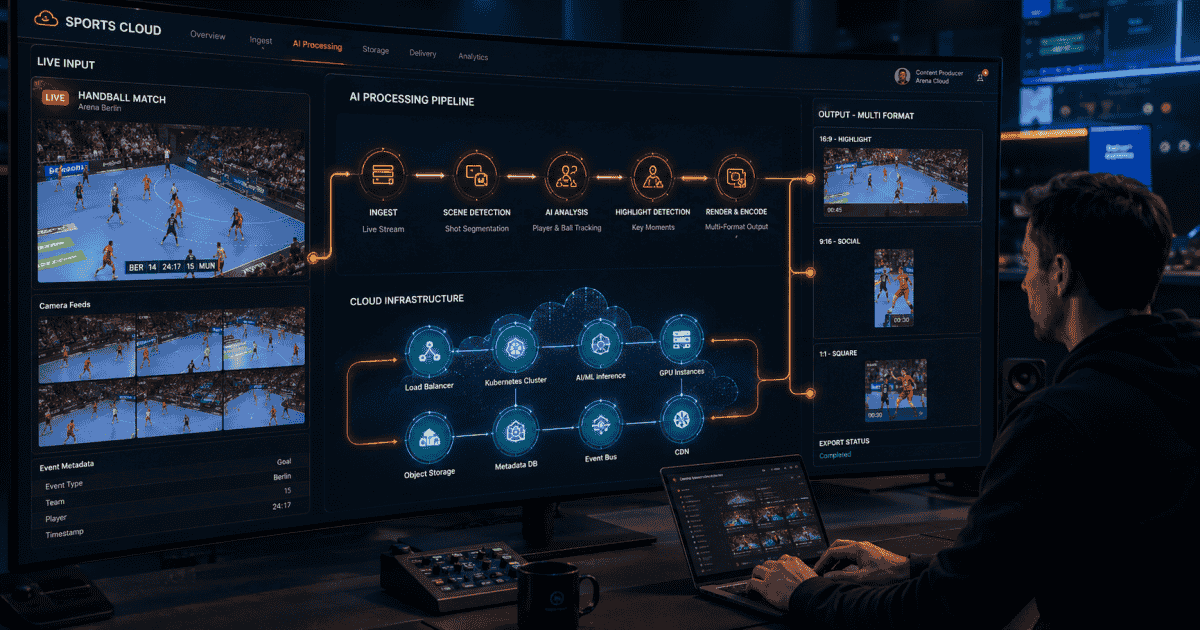
A production-grade short-form pipeline handles four steps automatically. First, AI detection identifies every significant moment from the live feed. Second, intelligent clipping sets editorial trim points. Third, AI reframing converts each clip to 9:16 with subject tracking. Fourth, branding templates apply overlays, watermarks and score graphics without manual intervention.
The output is a queue of publish-ready vertical clips, each formatted to platform specifications, available within 60 seconds of the live action. The social media manager's job shifts from production (clipping, cropping, branding) to distribution (choosing which clips go to which platform and in what order). That is a much more valuable use of their time and a workflow that scales to any number of concurrent matches.
For organizations covering multiple sports, the pipeline needs to work across all of them without sport-specific configuration. A system that handles football but requires manual setup for cricket or basketball is not scalable for a multi-sport broadcaster or OTT platform. The detection and reframing layers should generalize across 50+ sports with consistent quality.