
Why the RTMP-to-Publish Pipeline Is Still Broken for Most Sports Organizations
The gap between what happens on the field and what appears on social media is measured in minutes, not hours. Yet for most leagues and broadcasters, the content pipeline from live feed to published clip still runs through a manual editing queue. An operator monitors the stream, flags a moment, clips it in a production tool, exports the file, hands it to a social media manager, who adds branding and posts it. End to end, that process takes 5 to 15 minutes per clip on a good day.
Five minutes does not sound like much until you consider the competitive reality. Fan attention on social platforms is measured in seconds. A Premier League goal that appears on X within 45 seconds of the net bulging will outperform the same clip posted 10 minutes later by a factor of 3 to 5 in engagement. The first mover captures the share, the conversation and the algorithm boost. Everyone else is publishing into a feed that has already scrolled past.
The manual pipeline has a second structural problem: it does not scale. A single operator can realistically monitor one feed and produce one clip at a time. During a matchday with 8 concurrent games across a league, you need 8 operators minimum. For a multi-sport broadcaster covering football, basketball and handball simultaneously, the headcount balloons further. Each additional feed requires a trained person watching in real time.
This is not a talent problem. It is an architecture problem. The workflow was designed for a world where content had one destination (the broadcast) and one timeline (post-match). Social media demands dozens of outputs across multiple formats on a timeline measured from the moment of action. The pipeline needs to be rebuilt around automation, not optimized around human speed.
How Zero-Configuration Ingest Works
The first bottleneck in any live clipping workflow is getting the feed into the system. Traditional production setups require encoder configuration, protocol negotiation, resolution matching and input format validation before a single frame is processed. For organizations without dedicated broadcast engineers, this setup phase alone can take hours or require vendor support calls.
Modern AI sports video platforms solve this with zero-configuration ingest. The system accepts whatever you send it. Point your RTMP stream at the provided endpoint and the platform handles the rest: protocol detection, resolution adaptation, frame rate normalization and codec transcoding all happen automatically in the background.
The same applies to HLS and SRT feeds, which are increasingly common in professional broadcast environments where RTMP latency or reliability is a concern. And for organizations that do not stream live at all (youth leagues recording to camera cards, for example), direct file upload triggers the same AI pipeline against recorded footage. The input format changes but the output quality stays consistent.
This matters because it removes the technical barrier that keeps mid-tier leagues and regional broadcasters from adopting automated workflows. A state-level cricket association with a single camera and an RTMP encoder can access the same AI clipping capability as a Tier 1 football broadcaster with a full OB van. The ingest layer abstracts away the complexity so the content team can focus on distribution rather than encoding.
What Happens in Those 60 Seconds: The AI Processing Pipeline
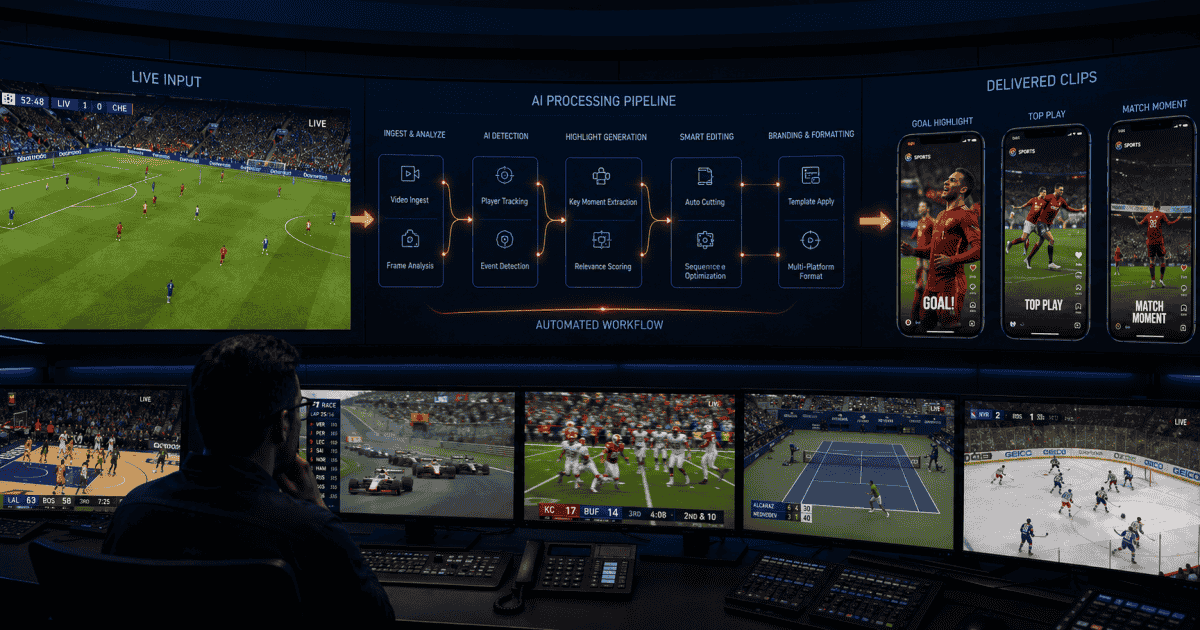
Once the feed is ingested, the clock starts. Here is what happens between the moment of live action and a finished, branded clip ready for publishing.
Step 1: Real-Time Moment Detection (0-5 seconds)
Multi-Dimensional AI Analysis
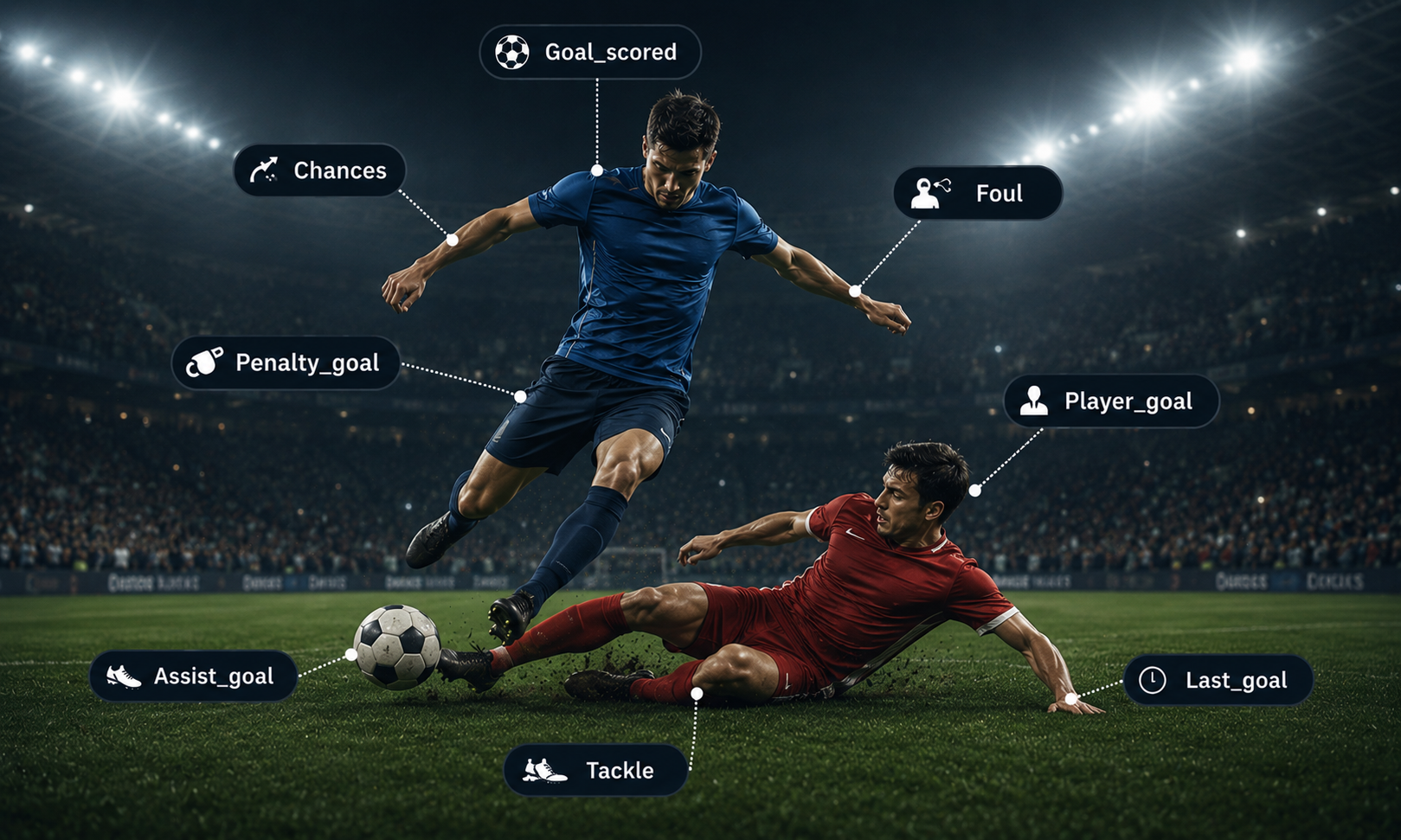
The AI monitors the live feed using multiple analysis layers running simultaneously. Computer vision identifies on-field events: goals, saves, dunks, wickets, fouls and celebrations. Audio analysis tracks crowd energy spikes, commentator excitement and whistle patterns. Scoreboard OCR reads score changes in real time. These signals are fused together to generate a confidence score for each detected moment. A goal with a crowd roar and commentator spike scores higher than a routine save with muted commentary. This is the same precision detection engine that processes over 50 sports without manual configuration.
Step 2: Intelligent Clipping (5-15 seconds)
Context-Aware Trim Points
Raw moment detection gives you a timestamp. Intelligent clipping gives you a watchable clip. The system determines optimal in and out points by analyzing the buildup to the moment (the pass before the goal, the dribble before the dunk) and the reaction afterward (celebration, replay angle, crowd shot). This produces clips that feel editorially complete rather than mechanically truncated. Clip duration adapts to the moment type: a 90th-minute winner gets a longer celebration window than a routine first-half goal.
Step 3: Branding and Overlay (15-30 seconds)
Automated Package Assembly
Each clip receives the organization's branding package automatically: intro bumper, lower-third scoreboard, logo watermark and outro card. These templates are configured once and applied to every clip without manual intervention. The system also generates contextual metadata: match name, competition, teams, score at the time of the moment and a descriptive caption suitable for social posting.
Step 4: Multi-Format Export (30-50 seconds)
AI Reframe for Every Platform
AI Reframe converts the 16:9 broadcast clip into 9:16 vertical and 1:1 square formats simultaneously. Rather than center-cropping (which cuts off action at the edges of the frame), the AI tracks the subject of interest and dynamically reframes around the ball, the scorer or the key action. This produces vertical clips where the action stays centered and watchable, not clips where goals happen off-screen because the camera was panned wide.
Step 5: Publish-Ready Delivery (50-60 seconds)
API Push or Dashboard Review
Finished clips are delivered to a dashboard for review or pushed directly to publishing endpoints via API. Organizations that want human approval before posting get a one-click approve-and-publish workflow. Organizations that trust the AI threshold can configure auto-publish rules: any moment above a certain confidence score goes live automatically. Either way, the clip is ready within 60 seconds of the live action.
Live Clipping vs. Post-Match Processing: When to Use Each
Live clipping during the match and batch processing after the final whistle serve different content strategies. Understanding when to use each determines whether you get maximum value from the pipeline.
Live clipping is for social-first distribution. The goal is speed: get key moments onto Instagram, TikTok, X and YouTube Shorts while the match is still being discussed. This drives engagement, grows follower counts and positions your brand as the first source for highlights in your sport. Every major moment should be live-clipped and published within that 60-second window.
Post-match processing is for editorial packages. Smart Live Recaps assemble a narrative-driven summary of the entire match: opening exchanges, turning points, key goals and the decisive moments that shaped the result. These packages require the full match context that is only available after the final whistle. They serve a different audience (fans who missed the match and want a 3 to 5 minute catch-up). Our guide to automated sports recaps covers this workflow in depth.
The strongest content strategy uses both. Live clips capture attention during the match. Post-match recaps capture the audience that arrives after. Together, they cover the full content lifecycle from first whistle to the next morning's commute.
Architecture Considerations for Broadcast Engineers
If you are evaluating live clipping platforms for your organization, these are the technical questions that separate production-grade systems from demo-ready prototypes.
Latency budget. Measure the total time from live action to published clip, not just the AI processing time. Some platforms report fast detection but require manual review queues that add 5 to 10 minutes of human latency. The system's speed only matters if the full pipeline (detection, clipping, branding, reformat, delivery) is automated end to end.
Concurrent feed capacity. Ask how many simultaneous feeds the platform can process at full quality. A system that handles one feed flawlessly but degrades at five is not ready for matchday operations. Look for platforms that scale horizontally rather than requiring capacity planning calls before each event weekend.
Protocol flexibility. RTMP is standard but not universal. SRT is gaining traction for its error correction over unreliable networks (especially relevant for remote venues). HLS is the default for OTT distribution. The platform should accept all three without requiring different integration paths for each.
4K processing speed. As more leagues move to 4K production, the AI pipeline needs to process higher-resolution feeds without proportional increases in latency. Ask for specific benchmarks: how long does a 4K clip take versus 1080p? Platforms optimized for 4K should process at speeds comparable to their HD pipeline, not 4x slower.
Sport-agnostic detection. If your organization covers multiple sports (most broadcasters and OTT platforms do), verify that the detection model works across all of them without sport-specific configuration. A system trained only on football will miss critical moments in cricket, handball or basketball. The detection layer should generalize across sports while still recognizing sport-specific events like wickets, three-pointers or penalty corners. Mid-tier leagues in particular benefit from platforms that support niche sports without requiring custom model training.
What to Look for in a Live Clipping Platform
Beyond the technical architecture, the platform's operational model determines whether it actually reduces your team's workload or simply moves the bottleneck from one tool to another.
Setup time matters more than feature count. A platform with 50 features that takes two weeks to configure is less valuable than one with 20 features that goes live in an afternoon. For organizations without dedicated broadcast engineering teams, zero-configuration ingest and pre-built branding templates are the difference between adopting the tool and abandoning it during onboarding.
Pricing should scale with usage, not with headcount. Manual workflows cost more as you add people. Automated pipelines should cost more only as you add feeds or processing volume. If the platform charges per seat, you are paying for a tool that still depends on human operators rather than one that replaces the need for them.
The reframe quality is the real differentiator. Every platform can clip a 16:9 video. The question is whether the vertical output is watchable. Center-crop produces clips where the action drifts out of frame on wide shots. AI-powered subject tracking keeps the ball, the scorer and the celebration visible regardless of camera angle. Ask to see vertical output from a real match before committing, not a cherry-picked demo reel.
API-first architecture enables downstream workflows. Clips should be accessible via API for integration with your CMS, social scheduling tools, OTT platform and data warehouse. If the only way to get clips out of the system is a manual download from a dashboard, the platform will become a bottleneck as your content volume grows.