
Why Match Recaps Are the Hardest Content to Scale
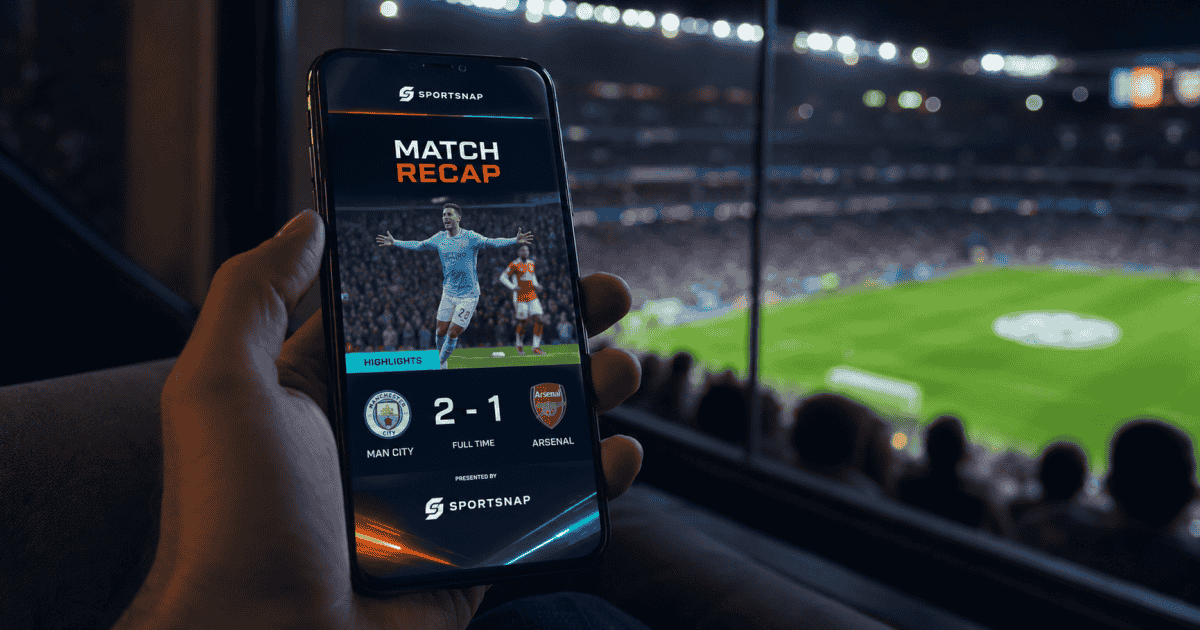
Highlights are individual moments. A goal, a dunk, a match point. They are relatively simple to produce because each clip stands alone. A recap is fundamentally different. It tells the story of an entire match: how it started, when momentum shifted, which moments defined the outcome and what the final result means in context. Producing that story requires editorial judgment about sequencing, pacing and significance.
Under a manual workflow, a recap editor watches the full match (or at minimum scrubs through the recording), identifies 10 to 20 key moments, decides on the narrative arc, trims each clip, arranges them in sequence, adds transitions and branding, then renders and exports. For a 90-minute football match, this takes 30 to 60 minutes of focused post-production. For a basketball game with dozens of lead changes and scoring runs, it can take longer because the narrative is more complex.
Now multiply that by a full matchday. A football league with 9 concurrent matches needs 9 separate recaps. A tennis tournament with 16 matches across multiple courts needs 16. A multi-sport broadcaster covering football, basketball and handball on the same evening might need 20 or more. Manual production at that scale requires a room full of editors, each working against the same post-match deadline when audience attention is highest.
This is the scaling problem that AI recap automation solves. Not by replacing the editorial decisions, but by handling the mechanical work (detection, clipping, assembly, branding, formatting) so that content teams can publish at a pace that matches audience demand.
How AI Builds a Match Recap Automatically
An automated recap is not a random collection of clips arranged chronologically. The best systems produce a structured narrative. Here is how the pipeline works from feed to finished product.
Continuous Monitoring and Moment Detection
While the match is in progress, the AI monitors the live feed using multiple analysis layers simultaneously. Computer vision identifies on-field events like goals, fouls, substitutions and celebrations. Audio analysis tracks crowd energy, commentator tone shifts and whistle patterns. Game context (score state, match clock, competitive significance) weights each detected moment against its editorial value.
This is the same multi-dimensional detection that powers real-time AI sports highlights, but for recaps the system retains the full event timeline rather than publishing individual clips. Every detected moment is logged with its timestamp, significance score and contextual metadata.
Narrative Assembly
When the match ends (or at any configured trigger point like halftime), the system assembles the recap. This is where automated recaps diverge from simple highlight compilations. The AI selects moments based on narrative logic rather than just chronological order or significance score alone.
An effective recap tells a story. It opens with the setting (early match tempo, first significant chance), escalates through the key turning points (first goal, momentum shifts, red cards, tactical changes) and resolves with the decisive moments and final outcome. The AI applies this structure by analyzing the distribution of significant events across the match timeline and selecting clips that represent each narrative phase.
At Zentag AI, this narrative assembly is built into the Smart Live Recap capability. The system does not wait for the final whistle to start building the story. It assembles and updates the recap continuously during the match, meaning a complete summary is available within seconds of the game ending rather than after a separate post-production cycle.
Branding, Formatting and Multi-Platform Output
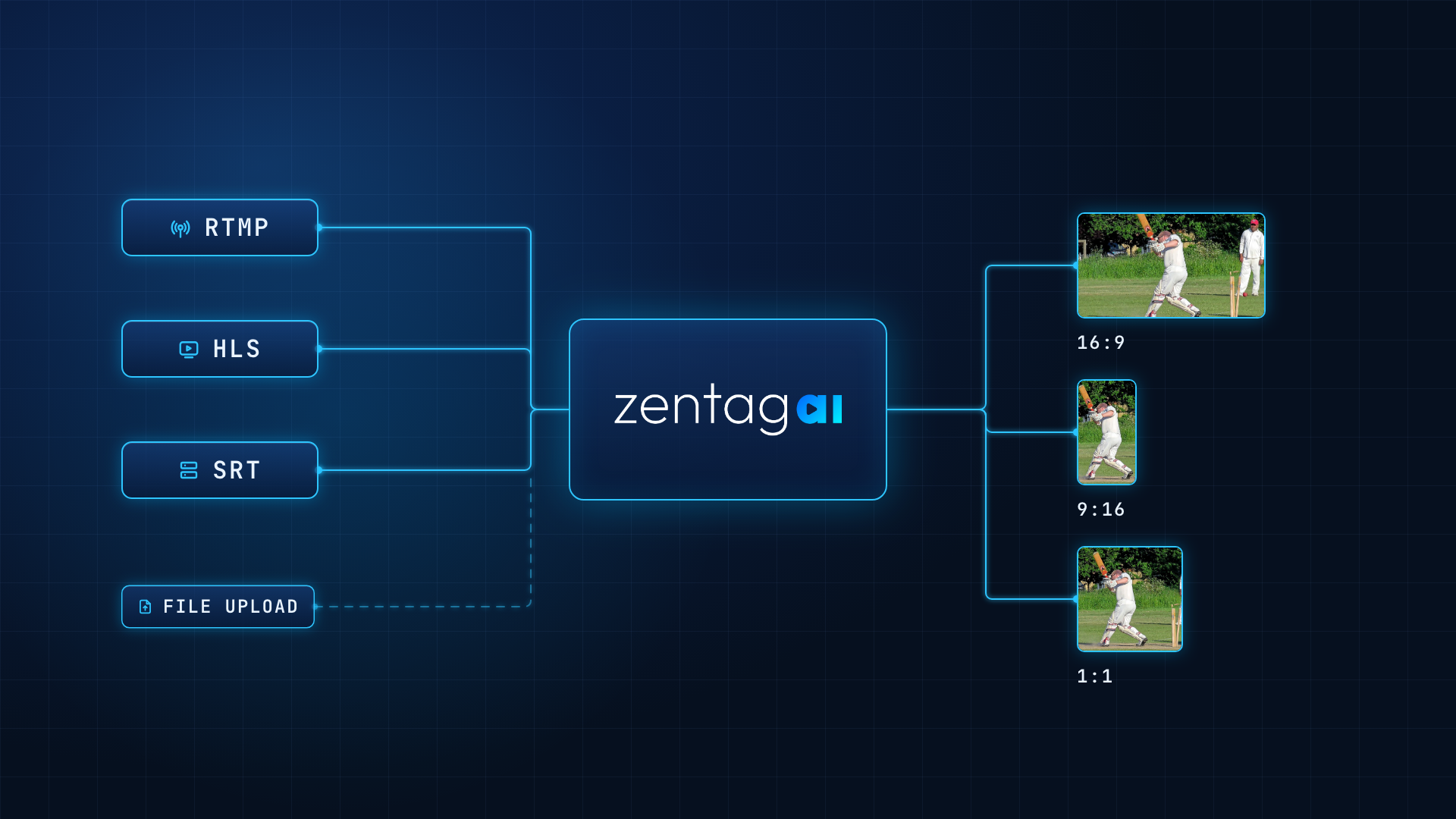
The assembled recap receives branding elements automatically: intro cards, score overlays, transition effects, lower thirds and outro cards with sponsor placements or call-to-action frames. For organizations distributing across multiple platforms, AI Reframe generates vertical 9:16 versions alongside the standard 16:9 broadcast format. A single recap becomes multiple distribution-ready assets without any additional editing.
Real-Time Recaps vs. Post-Match Recaps: Two Different Products
There is an important distinction between these two modes and understanding it helps when evaluating platforms.
Post-match recaps are the traditional model accelerated by AI. The system processes the complete match recording after the final whistle, selects the best moments, assembles them into a narrative and delivers a finished package. This is faster than manual production (minutes vs. an hour) but still operates on a delay.
Real-time recaps are fundamentally different. The system builds the recap as the match is happening, updating it continuously with each significant event. A viewer who tunes in at the 60th minute can watch a 90-second catch-up that covers everything important from the first hour. When the match ends, the recap is already complete. There is no post-production window at all.
Real-time recaps have a direct impact on engagement metrics for OTT platforms and broadcasters. A viewer joining late who immediately gets context watches longer. A viewer who is confused about what they missed is more likely to leave. The difference between these two outcomes is measured in average watch time, and for ad-supported platforms that translates directly to revenue.
The technical requirement for real-time recaps is significant. The platform must process video faster than it arrives, maintain a running event log, perform narrative assembly on the fly and deliver formatted output with near-zero latency. This is why general-purpose video editing tools cannot replicate the capability. It requires infrastructure purpose-built for live sports processing.
Who Benefits Most from Automated Recaps
Leagues and Federations Managing Multiple Competitions
A national football federation running a first division, second division and cup competition simultaneously might have 15 to 20 matches on a single weekend. Producing recaps for all of them manually would require a dedicated editing team. With AI automation, every match gets a professional recap regardless of whether it is the headline fixture or a lower-division game that would normally receive no coverage at all.
This is where the technology becomes an equalizer. Leagues and teams that previously could not afford post-production for every match can now deliver consistent content across their entire competition. Sponsors see coverage of every fixture, not just the marquee games. Fans of smaller clubs get the same recap quality as fans of the league leaders.
OTT Platforms Competing on Content Depth
For streaming platforms, recaps serve two strategic functions. First, they provide catch-up content for subscribers who missed the live broadcast. Second, they create shareable assets that drive new subscriptions. A compelling 3-minute recap posted to social media with a "Watch the full match on [Platform]" call to action is one of the most effective acquisition tools in sports streaming.
Automated recaps allow OTT platforms to produce this content for every match in their catalogue rather than just the premium fixtures. When your library includes recaps of 300 matches per season instead of 30, the depth of content available to subscribers increases dramatically.
Sports Media Publishers Racing the Clock
For digital sports media publishers, the first outlet to publish a match recap captures the majority of search traffic for that game. Post-match search volume peaks within 15 minutes of the final whistle and decays rapidly. An automated recap delivered within minutes of the final whistle captures that search window. A manually produced recap delivered 45 minutes later has already lost most of the organic traffic to whoever published first.
What Separates a Good Automated Recap from a Clip Reel
The gap between a well-produced automated recap and a chronological list of clips is significant, and it is what determines whether audiences actually watch the content.
Narrative structure matters. A good recap has a beginning, middle and end. It does not start with the first chronological event. It starts with whatever sets the stage for the story of the match, whether that is a dominant early performance, a shocking early goal or a tense opening period. The moments are selected and sequenced to convey how the match unfolded, not just what happened.
Moment selection requires context. A 3-0 match and a 3-2 match produce very different recaps even if both feature three goals from the same team. In the 3-0, the story is dominance. In the 3-2, the story is a comeback or a collapse. The AI needs to understand this difference and select supporting moments (defensive errors, momentum-shifting fouls, crowd reactions) that reinforce the narrative rather than just listing the goals.
Pacing drives watch-through rates. If every clip in a recap is a high-intensity moment, the viewer becomes desensitized and stops watching. Effective recaps vary the intensity: a quiet passage of play that sets up a dramatic goal, a near-miss that builds tension before the breakthrough. This pacing is what makes a recap feel like it was produced by an editor who watched the entire match, even when it was assembled by AI in seconds.
Production quality signals credibility. Branding, transitions, score overlays and platform-specific formatting are not cosmetic additions. They signal to the viewer that this is official, authoritative content produced by someone with access to the source material. A bare clip compilation without branding looks like fan-uploaded content, regardless of how good the moment selection is.
Getting Started: What Your Team Needs to Know
Implementing automated recaps does not require replacing your existing production workflow overnight. Most organizations start with one of two approaches.
Supplement first, then expand. Start by using AI recaps for matches that currently receive no post-production coverage. Lower-division games, early-round cup ties, youth competitions. This immediately increases your content output without disrupting existing workflows for premium fixtures. Once the team is comfortable with the quality and the editorial review process, expand to cover the full schedule.
Use real-time recaps for live engagement, manual packages for premium content. AI-generated recaps published in real time capture the immediate post-match audience. Your editorial team then produces a crafted, premium recap package for the flagship content section. Both products serve different audiences and different purposes. The AI handles the speed-dependent distribution while editors focus on the quality-dependent storytelling.
The critical factor in platform selection is whether the system can handle your specific sports, your branding requirements and your distribution channels without custom development for each. As we covered in our complete guide to AI sports highlights, the platforms worth evaluating are those built for multi-sport, multi-format automation from the ground up, not those retrofitting generic video tools with a sports layer on top.