

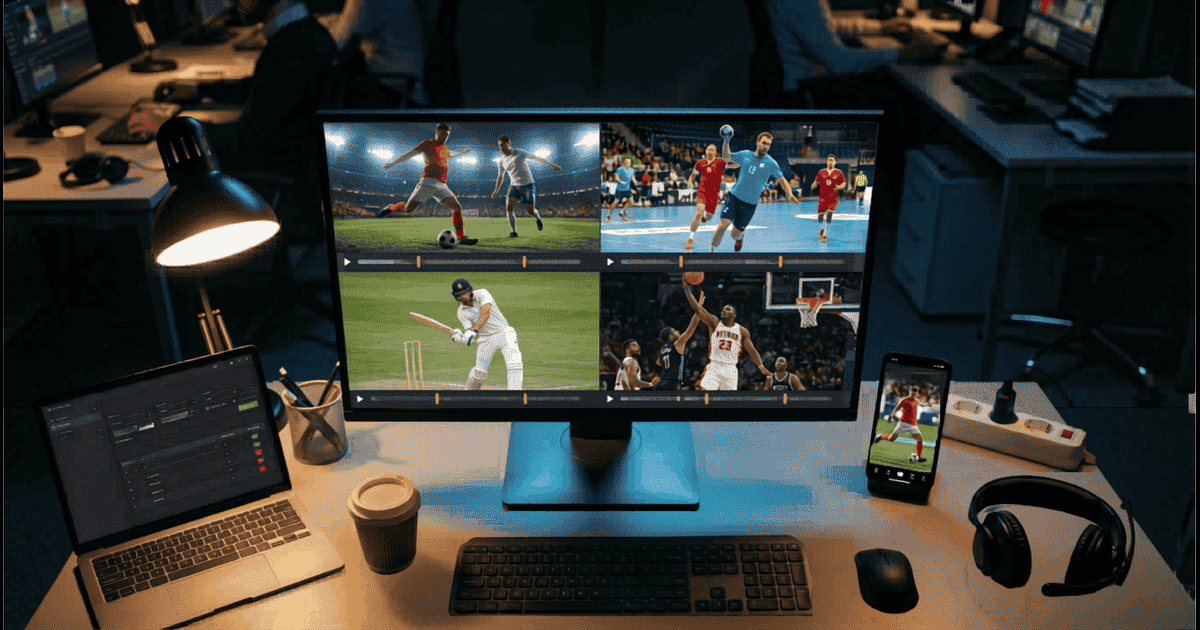
Why AI Sports Highlights Matter Now
The gap between what fans expect and what production teams can deliver has never been wider. Fans want highlights within seconds of a key moment. Social platforms reward speed with reach. A goal clip published within 60 seconds captures significantly more engagement than one posted 15 minutes later. Yet the traditional editing workflow, where a human editor watches the feed, marks a timestamp, scrubs back, trims the clip, adds branding, renders and uploads, takes 8 to 15 minutes per highlight.
Scale makes the problem worse. A mid-tier football league with 9 matches on a single matchday generates 90 to 135 potential highlight moments across those games. Covering that manually requires a team of editors working simultaneously, each costing between $40 and $100 per hour. For organizations managing rights across multiple sports the math becomes prohibitive.
This is why AI sports highlights have moved from experiment to essential infrastructure. According to Grand View Research, the AI in sports market reached $10.61 billion in 2025 and is projected to grow at over 21% annually through 2033. Automated video production is one of the fastest-growing segments within that market because it directly addresses the content volume problem every sports organization faces.
What Are AI Sports Highlights?
AI sports highlights are video clips of key moments, goals, dunks, tries, aces, dramatic saves, controversial decisions, that are detected and generated by artificial intelligence rather than human editors. The AI watches every frame of a live or recorded sports feed, identifies what matters and produces a finished, branded clip ready for publishing.
This is different from basic video trimming tools or generic AI editing software. A general-purpose video editor can cut a clip to length or add a filter. An AI sports highlights platform understands the sport. It knows that a 90th-minute equalizer with the crowd roaring is editorially more significant than a routine first-half goal in a lopsided match. It understands that the build-up to a goal, the celebration and the replay are all part of the story, not just the ball crossing the line.
The distinction between highlight detection and highlight packaging matters too. Detection is the AI identifying that something significant just happened. Packaging is everything that turns that detection into a publishable clip: trimming the right in and out points, applying branding and overlays, formatting for the target platform (horizontal for broadcast, vertical for TikTok, square for Twitter) and routing it to the right distribution channel. A complete AI sports highlights platform handles both.
The Market Behind the Shift
The numbers explain why every broadcaster suddenly has an AI roadmap. The AI-in-sports market was worth about 1.03 billion US dollars in 2024 and is projected to reach 2.61 billion by 2030, a compound annual growth rate above 16 percent. The broader AI in media and entertainment market is expected to exceed 30 billion dollars by 2027.
Three forces drive the growth: the explosion of data generated around every game, the competitive edge analytics provide and fan demand for instant, personalized content. Major broadcasters already operate this way; NBC Sports uses machine-learning systems that identify pivotal plays and deliver near real-time highlight packages and personalized clips across its digital platforms. What was experimental two years ago is now the baseline fans compare everything against.
How AI Finds the Moment: The Technology in Plain Language
Automated highlights rest on three layers working together.
Computer vision does the watching. Models trained on years of game footage recognize players, referees and the ball, track movement and detect actions: shots, saves, fouls, turnovers. Convolutional neural networks (CNNs) extract what is happening in each frame, while sequence models (RNNs and transformers) understand how frames connect over time, which is what separates a routine save from a match-winning block.
Audio and context analysis does the confirming. Crowd surges, commentary intensity and scoreboard changes spike together at moments that matter. When several signals agree, confidence rises and the system cuts the clip with the right lead-in and celebration.
Ranking and assembly does the editing. Machine-learning models score each moment for impact, using game state (scoreline, clock, stakes) and even engagement feedback from previously published clips to decide what makes the reel and in what order. Natural language processing on commentary and social reaction can further prioritize what fans actually responded to.
The result is not just detection but narrative judgment: highlight packages that feel coherent rather than mechanical.
How AI Detects and Creates Sports Highlights
Understanding the technical pipeline clarifies why AI sports highlights are faster and more consistent than manual editing. The process follows five stages, all running in real time.
Ingest
Everything starts when a video feed enters the system. Professional platforms accept standard broadcast protocols including RTMP, HLS and SRT for live streams as well as direct file uploads for archived content. At Zentag AI, ingest requires zero configuration. Connect your feed and the system starts processing immediately. This matters for organizations managing multiple simultaneous feeds because every minute spent on setup is a minute of missed content.
Multi-Signal Analysis
This is where AI sports highlights differ fundamentally from rule-based automation. Rather than relying on a single trigger like a scoreboard change, multi-dimensional AI analyzes several data streams simultaneously:
Computer vision identifies player actions, ball trajectory, goal-line events, celebrations, referee signals and crowd reactions frame by frame.
Audio analysis detects crowd noise spikes, commentator excitement, whistles and shifts in ambient energy. A sudden roar from the stands is often the first signal that something significant happened.
Game context uses scoreboard data, match clock and game state to weight each moment. An equalizer in the 89th minute scores higher than a fifth goal in a blowout because the editorial significance is higher.
Narrative arc detection identifies sequences that tell a story: a series of near-misses leading to a goal, a comeback building across several plays, or a dramatic penalty sequence.
When these signals converge the system produces a highlight automatically. As we detailed in our article on what automated sports video actually means, this multi-dimensional approach is what allows the system to detect not just goals but near-misses, dramatic saves, controversial decisions and emotional celebrations that audiences want to watch.
Moment Scoring and Clip Extraction
Each detected event receives a significance score. The system generates clips for moments that cross the configured threshold, applying intelligent trim points that capture the build-up and aftermath rather than cutting abruptly at the moment of action. This is the difference between a clip that feels like it was produced by an editor and one that feels like a surveillance camera caught something.
Branding, Overlays and Format Output
Generated clips automatically receive overlays, lower thirds, score bugs and any branding elements the content team has configured. For organizations publishing across multiple platforms, AI Reframe technology converts horizontal broadcast footage into vertical 9:16 formats optimized for Instagram Reels, TikTok and YouTube Shorts in a single pass. No re-editing required.
Distribution
Finished clips are ready for review, approval and publishing. The entire pipeline from live moment to social-ready clip takes seconds. For context, a manual editor would still be scrubbing back to the timestamp by the time the AI has already produced, branded and formatted the clip.
Who Uses AI Sports Highlights
The technology serves different segments of the sports media ecosystem, each with distinct requirements but the same underlying need: more content, faster, without proportionally increasing headcount.
Broadcasters and OTT Platforms
For broadcasters and OTT platforms, AI sports highlights solve the simultaneous coverage problem. A broadcaster managing rights across football, basketball, tennis and handball cannot staff a dedicated editing team for every live feed. Automated highlight generation allows a single operations team to oversee content creation across all feeds simultaneously.
The Smart Live Recap capability is particularly relevant here. Instead of producing highlights only after the match ends, AI generates rolling recaps during the game. A subscriber tuning in at halftime sees an intelligent catch-up that tells the story of the first half within seconds.
We explore this workflow in depth in our article on how broadcasters are turning live feeds into instant highlights.
Leagues and Federations
Leagues and teams face a budget version of the same challenge. They need to feed social channels, sponsor activations and fan platforms with fresh content during and after every match. But most organizations below the top tier do not have the production budget to staff editors for every game.
AI sports highlights become an equalizer. A volleyball federation in Brazil, a handball league in Germany or a T20 cricket tournament in India can produce the same quality of highlights as a tier-1 broadcaster without the production overhead.
We explore this in depth in our article on why mid-tier leagues deserve studio-quality highlights.
Digital Media and News Publishers
Sports media publishers compete on speed above almost everything else. The first outlet to publish a highlight captures the majority of search and social traffic for that moment. As we explored in our analysis of how digital media publishers accelerate the sports news cycle, AI-powered workflows allow newsrooms to publish while the audience is still talking about the play.
What Changes When You Automate: Before vs. After
The shift from manual to AI-powered highlights is not a marginal improvement. It is a structural change in how sports content is produced.
Time to first clip: Manual editing takes 8 to 15 minutes per highlight. AI produces clips in under 60 seconds from the moment of action.
Volume per match: A manual editor working a 90-minute match produces 8 to 12 clips in a two-hour post-production session. An AI system generates every significant moment as it happens, typically 15 to 30 clips per match, with no additional effort.
Multi-match coverage: A 9-match weekend that would require 9 editors and 18+ hours of post-production becomes an automated pipeline monitored by one or two operators.
Format versatility: Manual editors re-edit each clip for different platforms. AI Reframe handles horizontal-to-vertical conversion automatically from a single source clip.
Consistency: Human editors vary in judgment, speed and availability. An AI system applies the same detection criteria to every moment of every match regardless of time of day or workload.
The cost implications follow directly from these numbers. If a single editor costs $50/hour and you need 9 editors for a weekend's coverage, you are spending $900 in editing labor alone, before benefits, tools, or management overhead. An automated pipeline replaces the repetitive mechanical work while freeing editors to focus on storytelling, special packages and creative projects that actually require human judgment.
Real-Time vs. Post-Match: Two Modes of AI Highlights
Not all AI sports highlights work the same way. There are two distinct processing modes and understanding the difference matters when evaluating platforms.
Real-time processing analyzes a live feed as the game is happening. Highlights are generated within seconds of the on-field moment, enabling near-live publishing to social platforms and real-time fan engagement. This is the mode that powers Smart Live Recaps and in-game social clipping. It requires a platform capable of processing video faster than it arrives, which means high-performance infrastructure that most general-purpose video tools do not offer.
Post-match processing analyzes a complete game file after the final whistle. This mode is ideal for archive content, where organizations have years of historical footage sitting in storage without any clips, tags or metadata attached. Running archive footage through an AI highlights system creates a searchable library of moments that can be repurposed for compilations, anniversary content, documentary projects and social media.
The most capable platforms support both modes. Real-time for live games and post-match for archive management. Organizations that invest in only one mode leave significant content value on the table.
We break this down further in our guide to how AI generates match summaries in minutes.
Making It Work Across 50+ Sports
One of the most common questions about AI sports highlights is whether the technology works beyond football, basketball and the handful of major sports that generate the most training data. The answer depends entirely on the platform.
Most AI systems are trained on a narrow set of tier-1 sports because that is where the data is. Football and basketball have massive datasets of labeled footage. Handball, volleyball, field hockey, cricket and emerging sports have far less. Building detection models that work accurately across fundamentally different sports, from the continuous flow of football to the set-piece structure of volleyball to the burst scoring of basketball, requires a different architectural approach.
Zentag AI supports over 50 sports natively. The platform was not built for the Premier League and then stretched to cover everything else. The multi-dimensional AI that analyzes video, audio, crowd sentiment and game context adapts its detection models per sport. A goal in football, a dunk in basketball, a try in rugby and an ace in tennis are all structurally different events but the underlying signal architecture, visual pattern plus audio spike plus game context, applies universally.
This breadth matters because the sports organizations that need automated highlights the most are often the ones playing sports that other platforms do not fully support. A regional cricket board, a national handball federation or a women's volleyball league deserve the same quality of highlight coverage that a Premier League club receives.
4K, Speed and Scale: What to Look For in a Platform
As broadcast standards move to 4K and beyond, the processing demands on AI highlights platforms increase substantially. A 4K feed contains four times the pixel data of 1080p. If your platform processes 4K slowly, the automation advantage disappears because the pipeline itself becomes the bottleneck.
Zentag AI processes 4K footage at 10x the speed of real-time playback. This is not just a benchmark number. It is what makes automated highlights viable at broadcast quality. When you are processing multiple simultaneous 4K feeds across a weekend of matches, the difference between 2x speed and 10x speed determines whether your content is published while fans are still engaged or after they have moved on.
Beyond speed, here are the evaluation criteria that matter when selecting an AI sports highlights platform:
Ingest flexibility: Does the platform accept RTMP, HLS, SRT and file uploads without requiring custom integration?
Format output: Can it produce horizontal, vertical (9:16) and square formats from a single source clip automatically?
Branding control: Can your team configure overlays, lower thirds, score bugs and sponsor branding without developer involvement?
Sport coverage: How many sports does the detection model support natively? Is it limited to the major leagues or does it work for niche and emerging sports?
Real-time capability: Does the platform support live processing for near-live highlights or only post-match batch processing?
Archive processing: Can you run historical footage through the system to build a clip library from existing assets?
API access: Does the platform offer APIs for integration with your existing CMS, MAM or distribution workflow?
The Honest Challenges
Adopting AI highlights is not friction-free, and the organizations that handle these four issues deliberately get better results.
Data security and privacy. Highlight systems increasingly touch performance and even biometric data. That data needs clear governance: where it is stored, who accesses it and under what consent, especially under European rules.
Bias in training data. Models trained on incomplete footage can over-favor certain leagues, play styles or camera setups, producing skewed highlight selection. Diverse training data and human spot-checks are the safeguards.
Cost and the capability gap. Sophisticated AI was historically a big-budget purchase, widening the gap between top-tier organizations and everyone else. Cloud-based platforms have flattened this considerably, but procurement should still demand pilot-first proof.
Cultural trust. Editors, athletes and fans accustomed to human-crafted storytelling are rightly skeptical. Transparency about how moments are selected, plus a clear human review layer, builds the trust that makes the technology stick. AI should augment editorial judgment, not silently replace it.
Where AI Sports Highlights Are Heading
The trajectory of AI sports highlights points toward three developments that will reshape how sports content is created and consumed over the next few years.
Personalized highlight reels. Instead of one generic highlight package per match, AI will generate customized reels based on individual fan preferences: your favorite player, your team's plays, the moments that match your viewing history. The NBA has already experimented with this at scale, generating tens of thousands of personalized playoff highlight packages. This capability will become standard.
Deeper social integration. Short-form video consumption continues to accelerate. Sprout Social's 2026 video statistics report found that over 60% of social media users watch Reels and Shorts specifically for sports content. Deloitte's 2026 Digital Media Trends survey highlighted that a third of Gen Z do not subscribe to streaming services for sports because social clips are sufficient. AI platforms that can produce vertical, platform-optimized clips instantly will capture this audience.
Second-screen and in-venue experiences. AI highlights are extending beyond post-match social publishing into real-time fan experiences: in-stadium screens showing instant replays, companion apps with personalized match updates, and second-screen integrations that overlay highlights onto the live broadcast. The organizations that build this content pipeline now will be positioned for the next wave of fan engagement.
Where AI Sports Highlights Go Next
Biometric-aware highlights. Wearable sensor data will feed highlight selection, letting systems correlate athletic output with game outcomes: the sprint that set up the goal, not just the goal.
AR and VR replays. Immersive replays from a player's perspective, with interactive data overlays, will turn the highlight from a clip you watch into a moment you step inside.
Automated officiating crossover. The same computer vision that cuts highlights is learning to flag fouls and offsides in real time, which will add new authoritative angles to highlight packages.
Generative storytelling. Generative models will assemble personalized narrative reels, fusing multiple clips with consistent framing per fan, per platform, blurring the line between highlights and produced features.
The common thread: highlights stop being an after-product of the match and become a personalized, real-time layer of the sport itself. Teams and broadcasters building automated pipelines now are the ones positioned to ride each of these waves as they arrive.
AI sports highlights are not replacing human creativity. Editors, producers and storytellers remain essential for premium content, documentary work and narrative packages. What automation replaces is the repetitive mechanical work, the scrubbing, trimming, rendering and reformatting, that prevents creative teams from focusing on what they do best.



_.jpg "AI Video Tagging: A Practical Solution for Modern Sports Broadcasting")