
The Problem: Manual Editing Cannot Keep Up With Modern Sports
Think about what happens inside a typical sports production team after a match kicks off. An editor monitors the live feed. When something noteworthy happens they mark the timestamp, scrub back through the footage, isolate the clip, trim it to the right length, add lower thirds or branding, render the output and upload it to a CMS or social platform.
For a single highlight this process takes anywhere from 8 to 15 minutes depending on the complexity. For a full match producing 10 to 15 clips you are looking at two to three hours of post-production work.
Now multiply that by the reality of modern sports scheduling. A mid-tier football league might have 9 matches in a single matchday. A broadcaster covering multiple sports could be managing simultaneous football, basketball, handball and volleyball feeds. Even well-staffed production teams hit a ceiling.
The numbers tell the story. Professional video editors typically cost between $40 and $100 per hour depending on experience and market, according to ContentBeta's 2026 pricing analysis. Covering a 10-match weekend manually requires a team of editors working in shifts. Meanwhile the window for maximizing audience engagement on social media keeps shrinking. A highlight published within 60 seconds of a goal captures significantly more engagement than one posted 15 minutes later.
This is the bottleneck that automated sports video solves.
What Automated Sports Video Actually Means
Automated sports video is the use of AI to detect, clip, brand and distribute key moments from sports footage without manual intervention. It replaces the human scrub-and-cut workflow with a system that watches every frame of every feed simultaneously and makes editorial decisions in real time.
The technology brings together several AI capabilities working in concert:
Computer vision identifies what is happening visually, from player movements and ball trajectory to goal-line events, celebrations and referee signals.
Audio analysis detects crowd noise spikes, commentator excitement and whistles. These are signals that often indicate something significant just happened.
Game context uses scoreboard data and match state (an equalizer in the 89th minute vs. a fifth goal in a blowout) to score each moment's editorial significance.
Narrative arc detection identifies build-up sequences and emotional patterns that make a clip feel like a story rather than an isolated event.
When these signals converge the system generates a clip automatically. The output is not raw footage. It is a trimmed, branded and formatted highlight ready for publishing.
At Zentag AI, this multi-dimensional approach is central to how our platform works. Rather than relying on a single signal like scoreboard changes, we analyze video, audio, crowd sentiment and player reactions simultaneously. This is what allows the system to detect not just goals but near-misses, dramatic saves, controversial decisions and emotional celebrations that audiences actually want to watch.
How the Automated Pipeline Works: From Live Feed to Social Clip
Understanding the technical flow helps explain why automated sports video is faster and more consistent than manual editing.
Step 1: Ingest
The process begins when a live video feed enters the system. Zentag AI accepts standard broadcast protocols including RTMP, HLS and SRT streams as well as direct file uploads for archived content. The platform requires zero configuration for ingest. Connect your feed and the system begins processing immediately.
Step 2: Multi-Dimensional AI Analysis
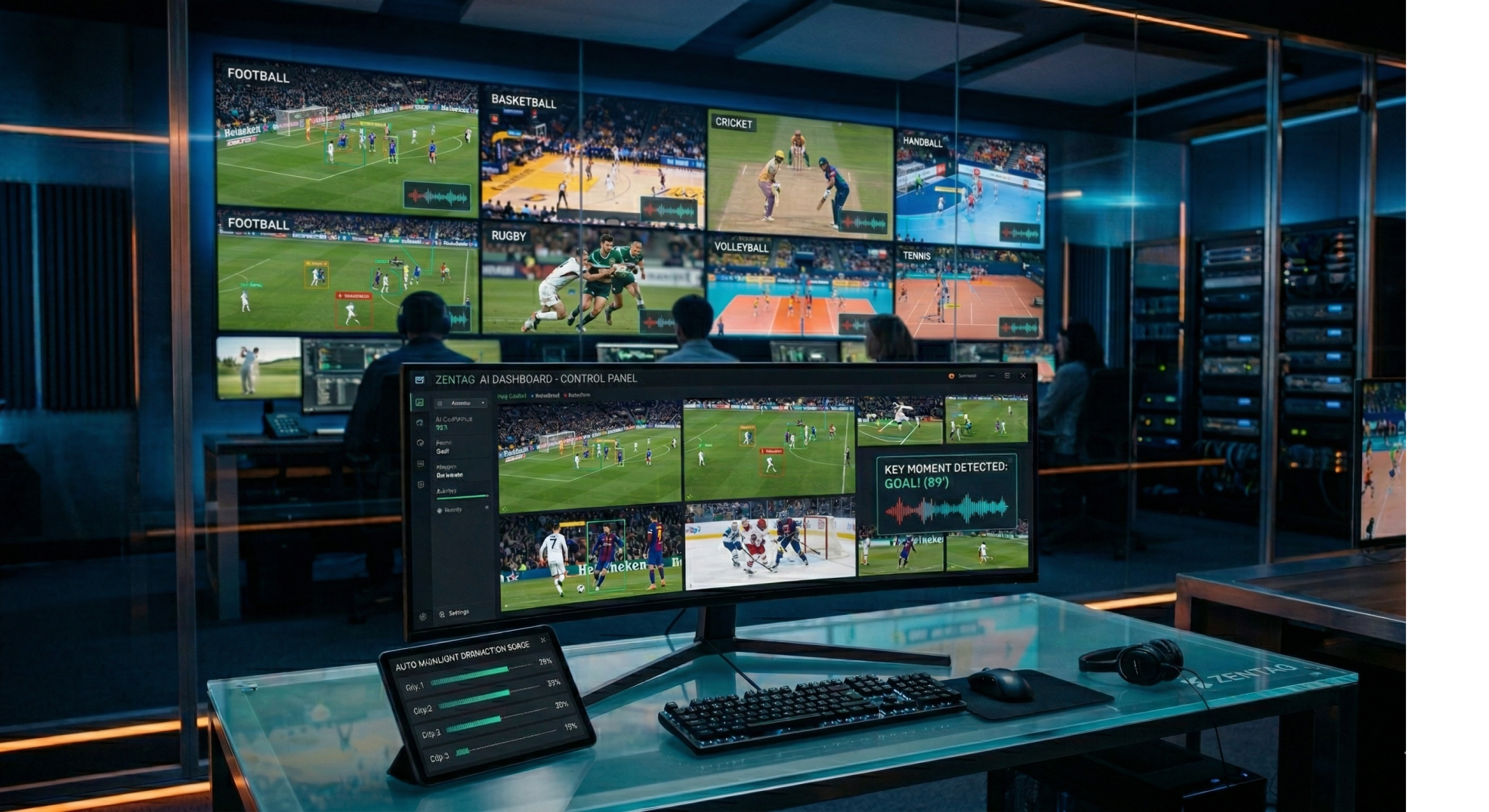
As the feed flows in the AI engine analyzes every frame across multiple dimensions simultaneously. Visual detection identifies player actions and game events. Audio analysis monitors crowd volume and commentary intensity. Game data integration tracks score changes and match context. All of this happens in real time, not after the match ends.
Step 3: Moment Scoring and Clip Generation
Each detected event receives a significance score based on the combined signals. A 90th-minute equalizer with the crowd at peak volume scores higher than a routine first-half goal. The system automatically generates clips for moments that cross the significance threshold, applying intelligent trim points that capture the build-up and aftermath rather than cutting abruptly.
Step 4: Branding and Formatting
Generated clips automatically receive overlays, lower thirds and branding elements configured by the content team. For organizations that publish across multiple platforms, Zentag AI's Reframe technology automatically converts horizontal broadcast footage into vertical 9:16 formats optimized for Instagram Reels, TikTok and YouTube Shorts.
Step 5: Distribution
Finished clips are ready for review, approval and publishing. The entire pipeline from live moment to social-ready clip takes seconds rather than the 8 to 15 minutes required for manual editing.
This speed matters because of the rights window problem. As WSC Sports noted in their media rights analysis, much of the competition today comes down to volume and how quickly content can be delivered to the public. If your production pipeline takes 15 minutes per clip you are burning a significant portion of that window on editing. Automated sports video compresses the production time to near zero, maximizing the distribution window.
Who Uses Automated Sports Video (And Why)
Different organizations adopt this technology for different reasons but the underlying driver is the same: more content, faster, without proportionally increasing headcount.
Broadcasters and OTT Platforms
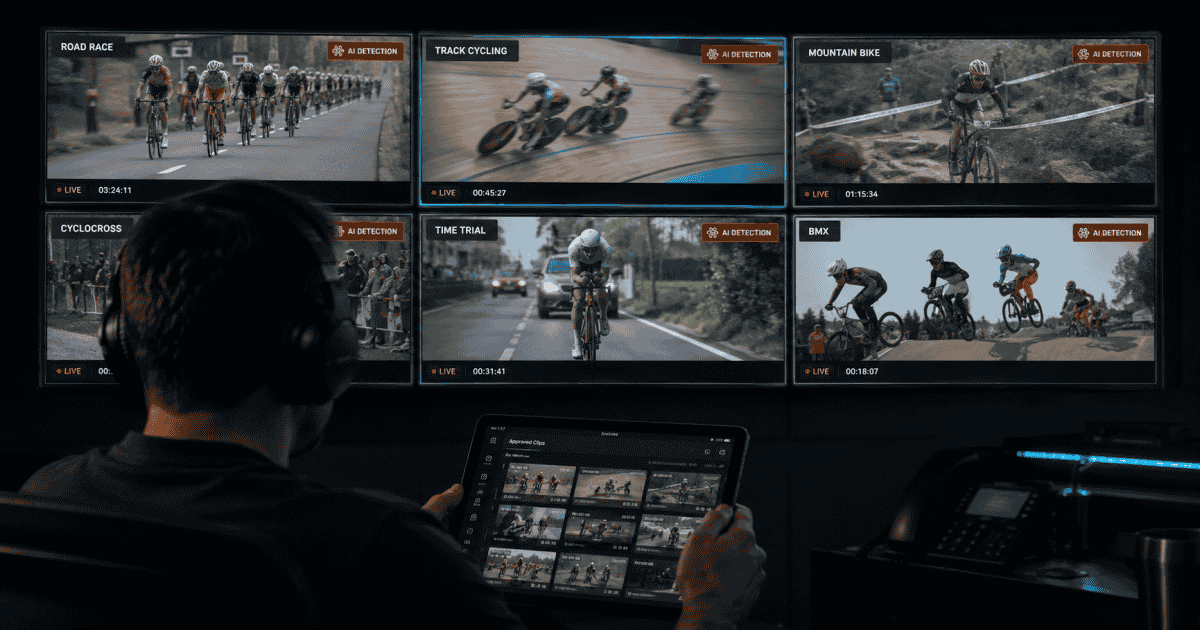
For broadcasters and OTT platforms, the challenge is covering multiple simultaneous events while maintaining quality. A broadcaster managing rights across football, basketball and tennis simply cannot staff a dedicated editing team for every feed. Automated sports video allows a single operations team to oversee highlight generation across all feeds simultaneously.
The Smart Live Recap feature is particularly relevant here. Instead of producing highlights only after the match, AI generates rolling recaps during the game. Subscribers who tune in late immediately see an intelligent catch-up that tells the story of the match so far.
Leagues and Teams
Leagues and teams face a different version of the same problem. They need to feed social channels with fresh content during and after every match but most mid-tier organizations do not have the production budget of a Premier League club. A regional handball federation or second-division football league still needs highlights to engage fans and attract sponsors.
This is where automated sports video becomes an equalizer. Zentag AI supports over 50 sports natively. That coverage is not limited to tier-1 sports where training data is abundant. The system works across volleyball, handball, cricket, basketball and emerging sports with the same precision. Budget no longer dictates whether your fans get professional highlights.
Digital Media Publishers
Sports media publishers compete on speed. The first outlet to publish a highlight captures the majority of search and social traffic for that moment. As we explored in our article on how digital media publishers accelerate the sports news cycle, AI-powered workflows allow newsrooms to publish highlights while the audience is still talking about the play.
What Changes When You Automate: Before and After
The difference between manual and automated workflows is not incremental. It is structural.
Time to first clip: Manual editing produces the first clip in 8 to 15 minutes after a key moment. Automated sports video produces it in under 60 seconds.
Clips per match: A manual editor working a 90-minute football match might produce 8 to 12 highlights in a two-hour post-production session. An automated system generates every significant moment as it happens, typically producing 15 to 30 clips per match without additional effort.
Multi-match coverage: Manual workflows require one editor per feed at minimum. Automated systems process multiple feeds simultaneously with no additional staffing. A 9-match weekend that would require 9 editors and 18+ hours of post-production becomes an automated pipeline monitored by one or two operators.
Format versatility: Manual editors must re-edit each clip for different platforms (horizontal for YouTube, vertical for Reels, square for Twitter). AI Reframe handles this conversion automatically from a single source clip.
Consistency: Human editors vary in judgment, speed and availability. An AI system applies the same detection criteria to every moment of every match ensuring consistent quality regardless of the time of day or workload.
The 50+ Sports Question
One of the most common questions we hear is whether automated sports video works beyond the major leagues. The honest answer from most platforms is "partially." Many AI systems are trained primarily on football, basketball or American football because those sports generate the most training data.
At Zentag AI we took a different approach. The platform supports over 50 sports natively. We did not build this for the Premier League and hope it works for handball. We built multi-dimensional AI that detects key moments across fundamentally different sports, from the continuous flow of football to the set-piece structure of volleyball to the rapid scoring of basketball.
This matters because the sports organizations that need automated video the most are often the ones playing sports that other platforms do not fully support. A volleyball federation in Brazil, a handball league in Germany, a T20 cricket tournament in India. These organizations generate content that audiences want to watch but cannot justify traditional production costs.
4K Processing and Why Speed Matters at Scale
As broadcast standards move to 4K and beyond, the processing demands on video platforms increase substantially. A 4K feed contains four times the pixel data of 1080p. This means AI systems must analyze significantly more data per frame without adding latency.
Zentag AI processes 4K footage at 10x the speed of real-time playback. This speed is not just a technical specification. It is what makes the entire automated pipeline viable at broadcast quality. If your system processes 4K slowly, the automation advantage disappears because the pipeline becomes the bottleneck instead of the editor.
For archive management this processing speed also means historical footage can be analyzed rapidly. A league with years of unprocessed archive footage can run it through the system to generate a searchable library of moments and create new content opportunities from existing assets.
Where Automated Sports Video Is Heading
According to Grand View Research, the AI in sports market reached $10.61 billion in 2025 and is projected to grow at over 21% annually through 2033. Within that, automated video production is one of the fastest-growing segments because it directly addresses the content volume problem facing every sports organization.
Short-form video consumption continues to accelerate. Sprout Social's 2026 video statistics report found that over 60% of social media users watch Instagram Reels and YouTube Shorts specifically for sports highlights. Meanwhile Deloitte's 2026 Digital Media Trends survey highlighted that a third of Gen Z do not subscribe to streaming services for sports because clips on social media are sufficient. The organizations that produce the most high-quality clips fastest will capture the largest share of fan attention.
The trajectory is clear. Automated sports video is not replacing human creativity. Editors, producers and storytellers remain essential. What automation replaces is the repetitive mechanical work, the scrubbing, trimming, rendering and reformatting, that prevents creative teams from focusing on what they do best.
At Zentag AI our platform is part of this shift toward AI-native sports production. Built by a team from Perform Group, DAZN and Data Sports Group, we designed the system from the ground up for live sports workflows. Zero-configuration ingest. Multi-dimensional AI detection. 50+ sports. 4K at 10x speed. Studio quality accessible to every league and team regardless of budget.