
What Dynamic Ad Insertion Is
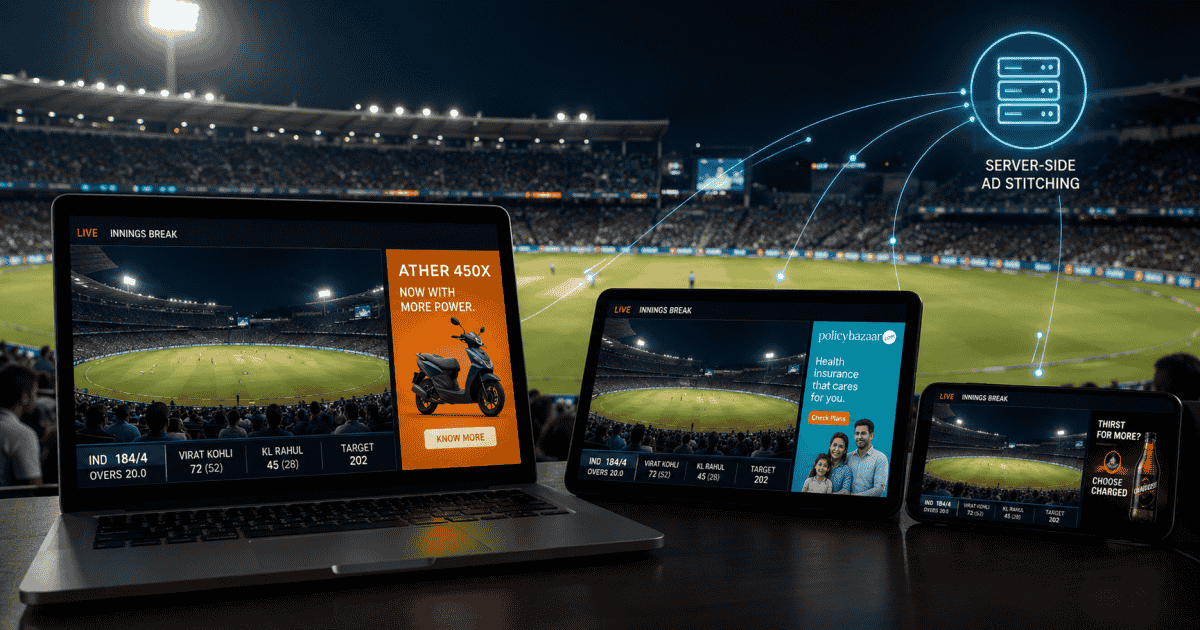
DAI is a server-side technology that inserts personalized ads into live or on-demand streams at the moment of delivery. Instead of every viewer seeing the same pre-baked commercial, the ad decision happens per viewer, per break, based on signals like location, device and viewing behavior.
Three properties make it different from older ad models:
Personalized delivery. Each viewer gets ads matched to their context, which is why advertisers pay premium rates for DAI inventory.
Seamless playback. Because the ad is stitched into the stream server-side, there is no player reload, no buffering spike at the break and far less ad fatigue.
Flexibility across models. The same infrastructure monetizes live streams, video-on-demand, time-shifted viewing and FAST-style channels. It supports SVOD, AVOD, TVOD and hybrid bundles.
The market context explains the urgency: the DAI market is projected to reach 8 billion dollars by 2030, and in the US alone OTT video advertising is set to generate 146.3 billion dollars in 2025. Ad-supported tiers have moved from fallback option to growth engine across the industry.
Under the hood, DAI runs on standard ad signaling. Markers in the stream tell the stitching server where each break sits and how long it runs: SCTE-35 cues for live events, and the VAST and VMAP standards for the ad payload and pod structure. For a live match the server has to read those markers and assemble the right pod in the seconds before the break opens, which is why ad-decision latency and stitching quality, not targeting alone, separate a strong DAI partner from a weak one.
Server-Side vs Client-Side: Why the Architecture Matters
Client-Side (CSAI) | Server-Side (DAI / SSAI) | |
|---|---|---|
Where the ad loads | In the player, via a separate request | Stitched into the stream before delivery |
Playback experience | Visible switch, buffering risk | Frame-accurate, broadcast-smooth |
Ad blockers | Often blocked | Largely immune |
Live streams | Fragile at scale | Designed for it |
Measurement | Mature but leaky | Requires good beaconing setup |
For live sports, the right answer is almost always server-side. Sports breaks are short, unpredictable and high-stakes: a 20-second buffering hiccup during a penalty shootout break is how you lose a subscriber. Choose a DAI partner that supports server-side stitching and real-time bidding. That combination is what unlocks programmatic demand.
Why Sports Is Premium DAI Inventory
Not all streaming inventory is worth the same, and sports sits at the top of the stack for reasons that compound. Live sport is appointment viewing: audiences arrive at a known time, in large simultaneous numbers, and they lean forward rather than half-watch. That concentrated attention is exactly what brands pay premiums for, and it gets scarcer every year as general entertainment fragments across dozens of services.
The format helps too. Sport comes with natural ad pods built into the event: halftime, innings breaks, timeouts, the pause before a penalty. Viewers expect a break there, so a well-stitched ad reads as native rather than as an interruption. The content is brand-safe by default, which matters to advertisers who will not run against unpredictable user-generated video. Taken together, live sport gives DAI a rare mix of high attention, predictable break structure, brand safety and a built-in reason for the viewer to sit through the ad. That is why a sold-out match break can clear several times the CPM of the same advertiser's general on-demand inventory.
The Revenue Math
An illustrative model shows where the money comes from. Suppose a sports OTT service delivers one million ad impressions per month:
Before DAI: generic spots at a 12 dollar CPM, with only 60 percent of inventory filled. Revenue: 1,000,000 x 0.60 x 12 / 1,000 = 7,200 dollars per month.
With DAI: targeted impressions at a 20 dollar CPM and 90 percent fill, because programmatic demand can bid on every break. Revenue: 1,000,000 x 0.90 x 20 / 1,000 = 18,000 dollars per month.
The numbers are illustrative, but the two levers are real and compound: targeting raises the price per impression and connected demand raises the share of impressions that get sold at all. Industry benchmarks cited by Streaming Media put the realistic uplift from targeted ads at 20 to 30 percent of ad revenue even before fill-rate gains, and 67 percent of viewers say they prefer personalized ads to irrelevant ones, which protects retention while monetization climbs.
There is a third lever the simple model hides: the size of the impression base itself. The math above holds the impressions fixed at one million, but that number is not fixed. It is a direct function of how much monetizable content you produce, and manual editing caps it hard. A platform that hand-cuts two or three clips per match has a small pool no matter how sharp its DAI yield is. A platform that automatically generates dozens of clips, recaps and vertical cuts grows the impression base itself, then earns the higher CPM and fill rate on top. Yield and content automation multiply each other, they do not just add.
A single match makes it concrete. Covered the old way, you have maybe three monetizable units: two live breaks and one post-match highlight. Covered with an automated pipeline, the same match yields those live breaks plus fifteen or twenty individual clips, a halftime recap, a full-time recap and a set of vertical cuts, every one of them a DAI slot. Same rights, same event, the inventory multiplied without a single extra editor, and DAI prices each slot to the right buyer.
Where DAI Fits in a Sports Streaming Service
Live match breaks. The classic slot: halftime, innings breaks, timeouts. DAI fills these with targeted spots instead of slates or repeated house promos.
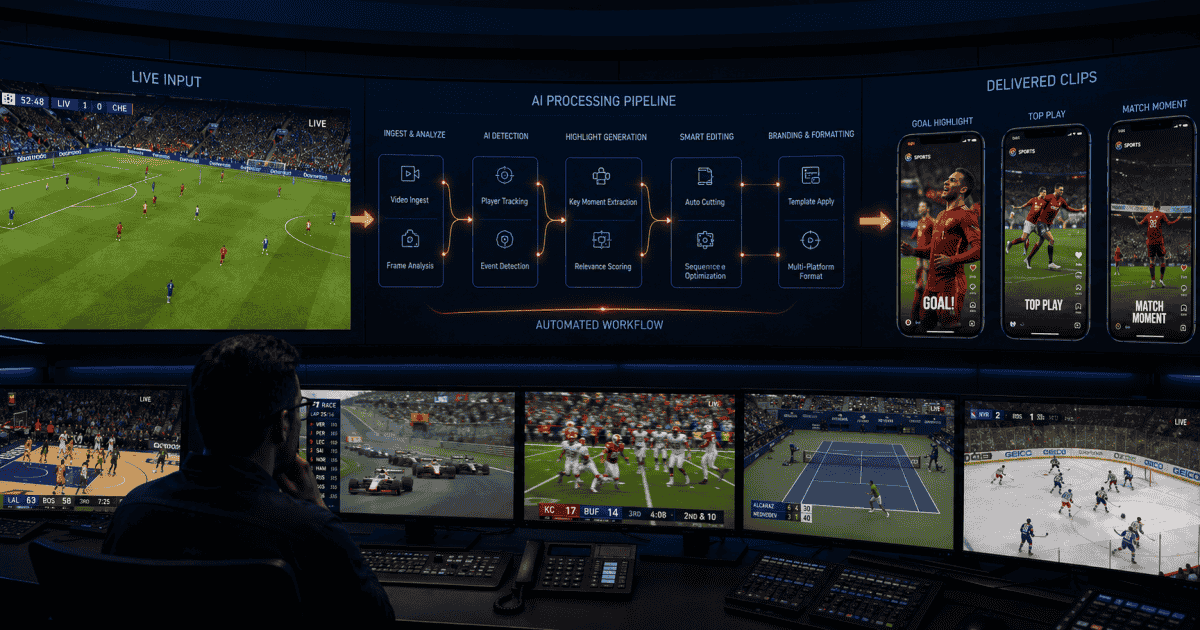
On-demand highlights. Every clip is pre-roll or mid-roll inventory. This is where automation changes the economics: a platform generating AI sports video highlights produces dozens of monetizable assets per match instead of two or three hand-cut clips. More supply, every unit targeted.
Evolving recaps. Halftime and full-time recaps are natural sponsorship and ad units: high intent, predictable placement, no interruption of live action. Smart Live Recap generates them automatically, so the inventory exists for every match, not just featured ones.
Archive and FAST channels. Tagged archive content can run as themed channels (classic matches, best-of compilations) with DAI filling every break. The archive you already own becomes a standing revenue stream.
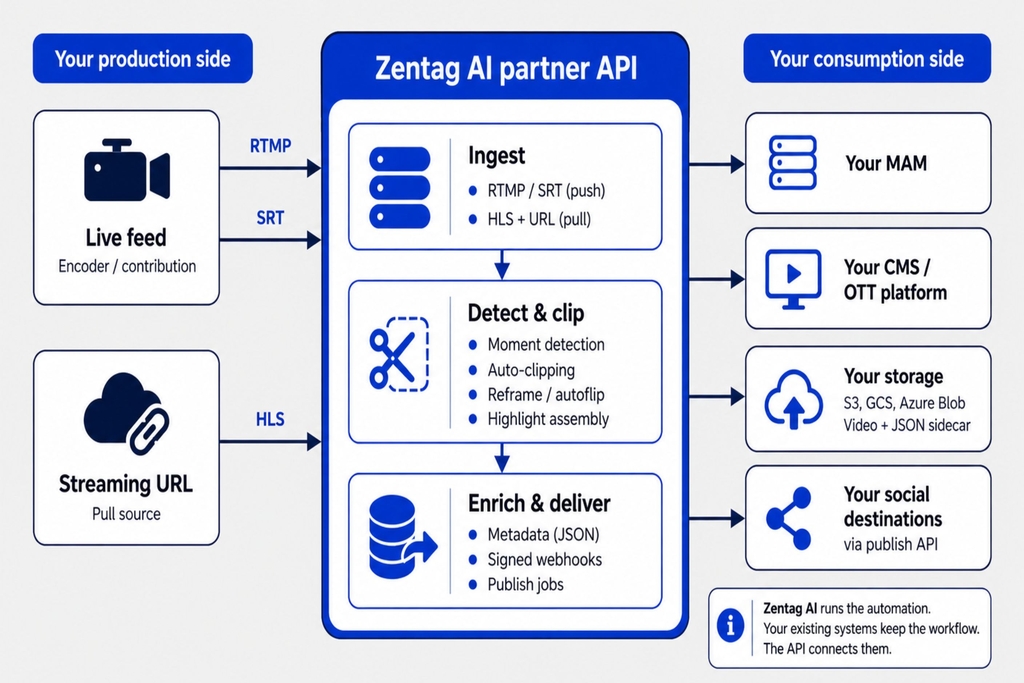
The strategic point: DAI monetizes whatever inventory you have, and AI content automation multiplies how much inventory you have. Platforms that deploy both get the compounding effect. The broadcaster and OTT solutions from Zentag cover the content side of that pairing.
Rolling Out DAI in Four Steps
1. Audit your inventory and data. Count your monetizable units: live break minutes per month, VOD plays and highlight views. Then audit your viewer data: what targeting signals (geo, device, sign-in data, viewing history) can you legally activate? Gaps here cap your CPM ceiling, so fix consent flows early.
2. Choose the stack. Shortlist DAI partners on five criteria: server-side stitching quality (frame accuracy at scale), real-time bidding connections to programmatic demand, DRM and player compatibility, measurement and beaconing standards and transparent fees. Run references with a platform of similar scale before committing.
3. Pilot on one content type. Start with VOD highlights rather than live: lower risk, faster iteration. Benchmark CPM, fill rate and completion rate against your pre-DAI baseline for at least a month. Watch completion especially: if stitching quality is poor, completion drops and the CPM gain is offset by audience loss.
4. Scale and optimize. Extend to live breaks and recaps once the pilot holds. From there, optimization is continuous: test ad load (fewer, better-targeted spots usually beat more spots), test creative formats and review yield weekly. Platforms that treat DAI as a live product, not an installation, are the ones that capture the year-over-year digital ad growth the IAB keeps reporting. Organizations already using AI-driven broadcast workflows find the scaling step easier because the content pipeline is already automated.
Metrics That Tell You It Is Working
eCPM: effective revenue per thousand impressions. The headline number.
Fill rate: percentage of ad opportunities actually sold. Unsold breaks are the cheapest revenue to recover.
Completion rate: viewers finishing ads. A health check on stitching quality and ad load.
Revenue per user per month: connects ad performance to business performance, especially on free tiers.
Churn on ad-supported tiers: confirms monetization is not burning retention. Relevant ads should hold or improve this number.
Read these together, not in isolation. A rising eCPM means little if completion is falling, because that pattern usually means you are squeezing more ads into each break at the cost of the experience. The healthy shape is eCPM and fill rate climbing while completion and churn hold steady, which is the proof that better targeting, rather than heavier ad load, is doing the work.
Common Pitfalls
Too many ads too soon. Overloading breaks tanks completion and retention. Start light, earn the right to add load.
Ignoring latency. Badly configured stitching adds stream delay, which matters enormously in sports where a push notification can spoil a goal before the viewer sees it.
Privacy shortcuts. Targeting requires consent. Build consent management properly per region (GDPR in Europe especially) before activating personal signals.
Measurement mismatches. Agree on counting methodology with advertisers up front. Server-side setups need clean beaconing to avoid billing disputes.
Treating live and VOD identically. They have different latency tolerances, break structures and demand profiles. A single one-size ad strategy under-monetizes both.
No fallback for unsold breaks. When demand does not fill a pod, the stream needs a graceful fallback such as a house promo or sponsor bumper, not dead air or a frozen frame that reads as a broken stream.
Dynamic ad insertion gives OTT platforms the edge to raise revenue per viewer while keeping the experience broadcast-smooth. The platforms winning in 2026 pair it with automated content production, so every match generates more inventory and every unit of inventory earns more.